I Mustache You A Question
Ten years after arriving at Lawrenceville, Head of School Steve Murray reflects on his evolving sense of kinship with his twelve predecessors, the enduring power of the Harkness table — and the origins of his signature look.

The very first time I met Steve Murray H’54 ’55 ’63 ’65 ’16 P’16 ’21 was inside his office in the Mackenzie Administration Building early on a sultry late July morning in 2015. I had begun my role as editor of The Lawrentian just a month before, and Steve was still unpacking after his move from suburban Cleveland, where he had led the University School for the previous ten years. I was there to interview him for the cover story in that fall’s issue of this magazine, the first comprehensive portrait of Lawrenceville’s 13th head of school its alumni would read.
We had a wide-ranging conversation that day, in which I learned much about him and his values as they pertained to his stewardship of Lawrenceville. I had a list of questions, but we let the conversation lead us. Only when I returned to my office did I realize I had forgotten to ask Steve about his signature mustache. So, as we checked in again this past November in the same office— now filled with mementos and other markings of his first ten years at the School — I made sure to get that one settled straightaway.
This interview was conducted prior to Murray’s announcement that he would step down at the end of the 2026-27 academic year. It has been edited and condensed for length and clarity.
* * *
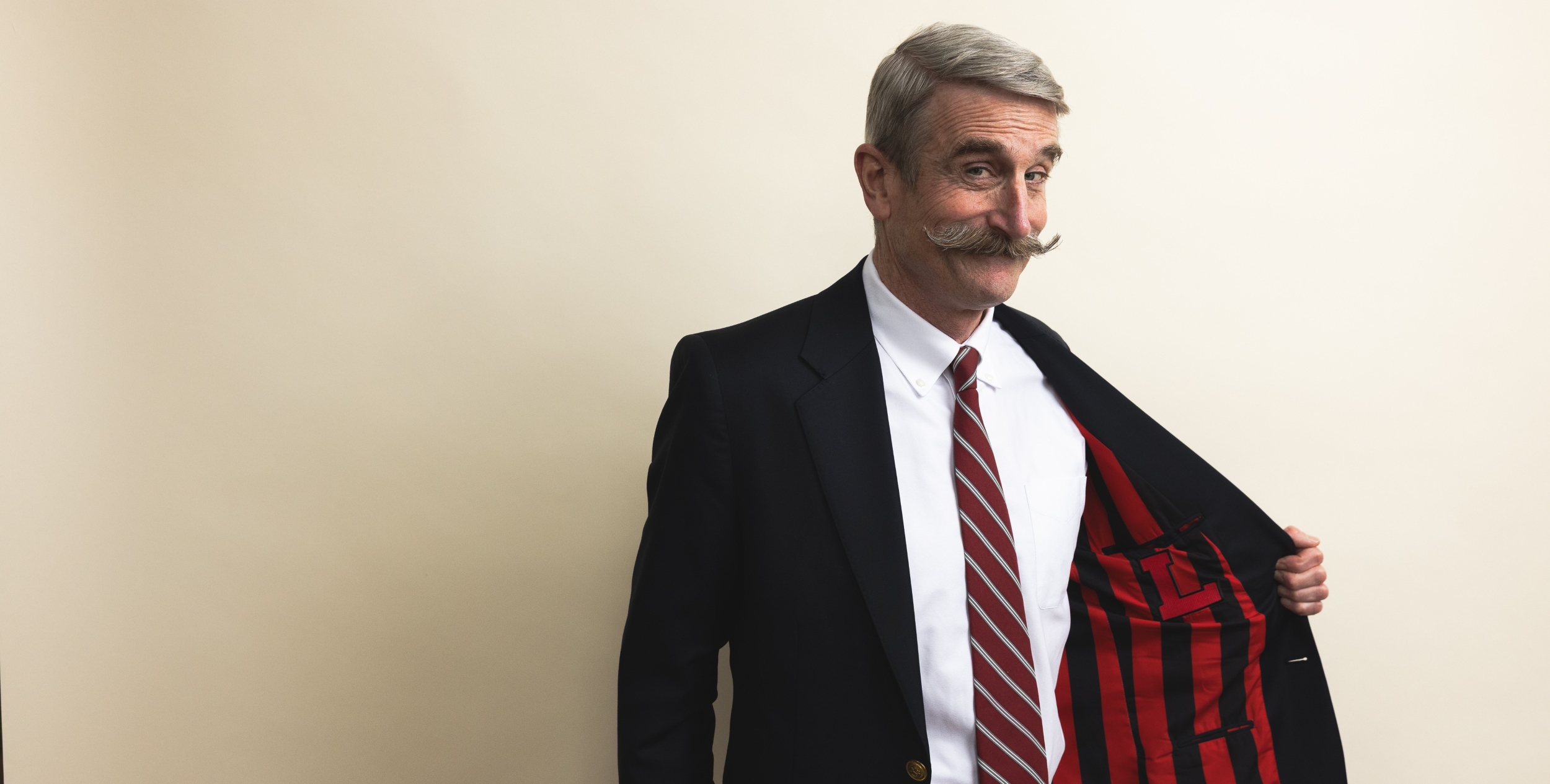
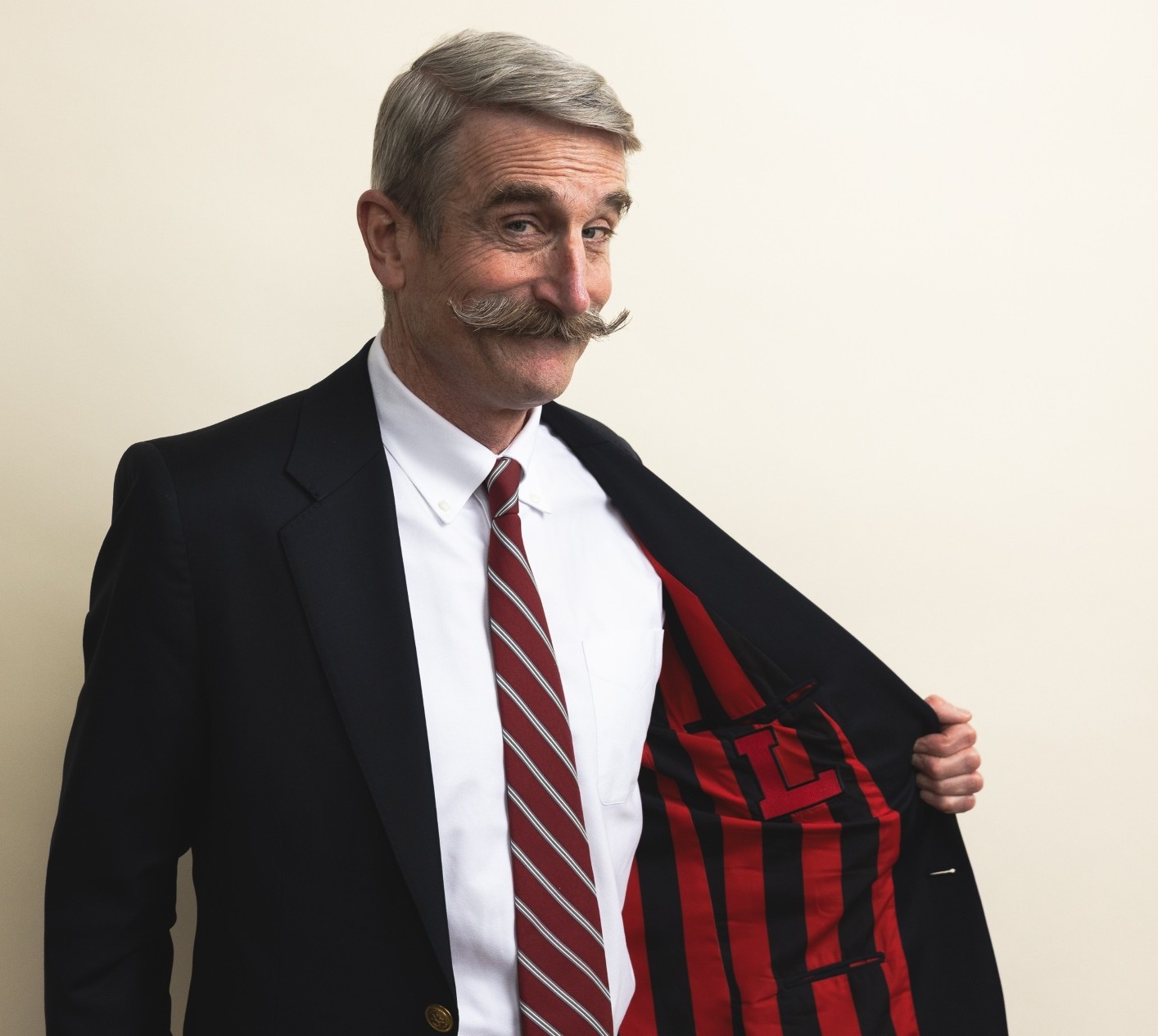
The Lawrentian: Your mustache is your signature physical trait. I recall you telling the tale once at School meeting, but I don’t think we’ve ever actually addressed it for our readers, so what is its origin story?
Steve Murray: I’ve had it for 42 years. I had tried a couple of times earlier in college to grow a mustache, and those were failed attempts. And then I was 20, studying for the year in Paris, and it just suddenly came in the way you see it now, essentially. I was pleasantly surprised that I actually could grow a mustache. And it wasn’t until a number of years later, I was up in the attic of my grandparents’ house, and I saw a portrait up on the wall from an ancestor from probably the late 19th century. My wife [Sarah Murray P’16 ’21] said, “Hey, look, there’s your mustache!” It felt kind of reassuring that this, maybe, is a family trait.
The Lawrentian: And you’ve never shaved it?
Murray: I did shave it once. It was a fundraiser in Cleveland for St. Baldrick’s, where students were shaving their heads and raising money for pediatric cancer research, and they were raising quite a bit of money. There was a “Shave the ’Stache” versus “Save the ’Stache” contest within the school to raise money, and I said, “Well, whoever raises more money, that’s what we’ll do.” Shave the ’Stache won, so I shaved it in front of the whole school. I grew it right back, but briefly, I was without a mustache, and my wife of 37 years commented that it was a little bit like having an affair. I said, “Well, good thing it’s with me!”
The Lawrentian: We had a conversation similar to this one at your five-year mark in which you mentioned that every time you are in Alumni Study, you feel the eyes of your twelve predecessors, whose painted portraits hang on the walls there, and of feeling “a keen obligation to build on their good work, to be worthy of following in their footsteps, and to not let them down or disappoint them.” Do you still feel that duty to them?
Murray: Yeah, I definitely do. I think back on the challenges that they endured over time, and they all had them. There was the Depression, World War II, the 1960s and that whole period of social transition, obviously the Vietnam War … there’ve been some major challenges to their leadership, so I still think they’ve “done their time.” I do still feel an obligation to be worthy of their respect, but I might call it, at this point, more of a kinship, because I’ve had my share at this point. And so, I hope — I think — I would’ve earned their respect, or have earned their respect. But we all stand on the shoulders of the giants that have preceded us, and I’m pretty aware of that. They built a great school that I have had the privilege of being a part of, and I don’t want to let them down.
The Lawrentian: That’s an interesting shift, where there’s more of a kinship now than there was when you were “the new guy” here and looking up to them, with all that history and trying to meet the moment.
Murray: I guess you could say as I walk around Alumni Study, I feel a little more like I can look them in the eye and say, “I now know what it feels like.”
The Lawrentian: During that same conversation, you brought up the Louis Auchincloss novel, The Rector of Justin, which presents a portrait of the main character, the head of a fictional New England boarding school, from a series of different perspectives, each written by another character. Reading it later made me appreciate how the head of a school has to be so many things to so many very different constituencies. How hard is that to do, knowing that many times, these folks will want different things from you and that those things aren’t always aligned with the others?
Murray: That’s a great question. It is one of the difficult aspects of the job, I suppose. One of the things I’ve learned over time, when people come to you and express their concerns, is to not take things personally, and understand that part of what’s being expressed is what people need from your position. Sometimes there are things that I can and should do differently, and so you listen to what people need from you.
I also have learned over time I can’t rely on people assuming my good intentions if there’s something difficult happening. People don’t always give you that grace at first. An example would be if you’re making hard but responsible decisions around budget. We are a very well-resourced school, but we can’t continually kick the can down the road for the next generation. I can’t always rely on people to understand that or to accept that, but I try to approach things with integrity and transparency, and if you do that steadily over time, even if people don’t always immediately respond, they come around. At least that’s how I operate.
I do still feel an obligation to be worthy of their respect, but I might call it, at this point, more of a kinship.
The Lawrentian: Yours is a unique job, being the most visible person at one of the nation’s most visible independent schools. You seemed keenly aware of this ten years ago, but in the time since, we have had a once-in-a-century pandemic, seen a dramatic rise in political polarization, and the internet has become an efficient accelerator for misinformation. Now, we see the rise of AI, which offers so much promise, but also a myriad of challenges. Does any of this change your role from how you might have seen it in 2015?
Murray: I don’t think it really changes my role. My goal is to offer steady, unwavering leadership, and I think it’s all the more important as things are rapidly changing. I wouldn’t call myself a “North Star,” but I think people are looking for things to believe in, and Lawrenceville, as an institution, is an entity people can believe in, and leadership is important.
I sometimes think my most important role, precisely because of how fast things change and the speed with which a crisis can erupt, is to stay calm and help people keep the faith that our institution is far stronger and far more resilient than they might feel at a tenuous moment, especially in the midst of a challenge.
The Lawrentian: We also talked then about the role of tradition at a place like Lawrenceville and how while it is always important, it is also often a matter of perception. Something as radical as the Harkness method became fundamental to this school, despite how disruptive it was in 1937. You said that “Great schools don’t remain great by sitting still.” How difficult is it to know when it’s time to move on from a long-standing tradition in order to move Lawrenceville forward?
Murray: We had a gathering of the heads of the Eight Schools Association last spring, along with our board leadership and our board presidents, and we had a guest speaker, Brian Rosenberg, who was the longtime president of Macalester College. He’s written a really great book called Whatever It Is, I’m Against It, about faculty culture and resistance to change in higher education, and I think a lot of it is rather applicable to places like Lawrenceville. He’s very funny and very thoughtful in his observations, and he’s very self-effacing; his aim is not to criticize faculty, but he was really speaking for himself as a former faculty member who was very much part of that mindset.
Rosenberg said one of the great strengths of higher ed and institutions of learning is their dogged insistence on staying true to their enduring purpose, and one of the great vulnerabilities is their dogged insistence on staying true to their enduring purpose and failing to see moments where they need to adapt. It can blind you to the need to innovate.
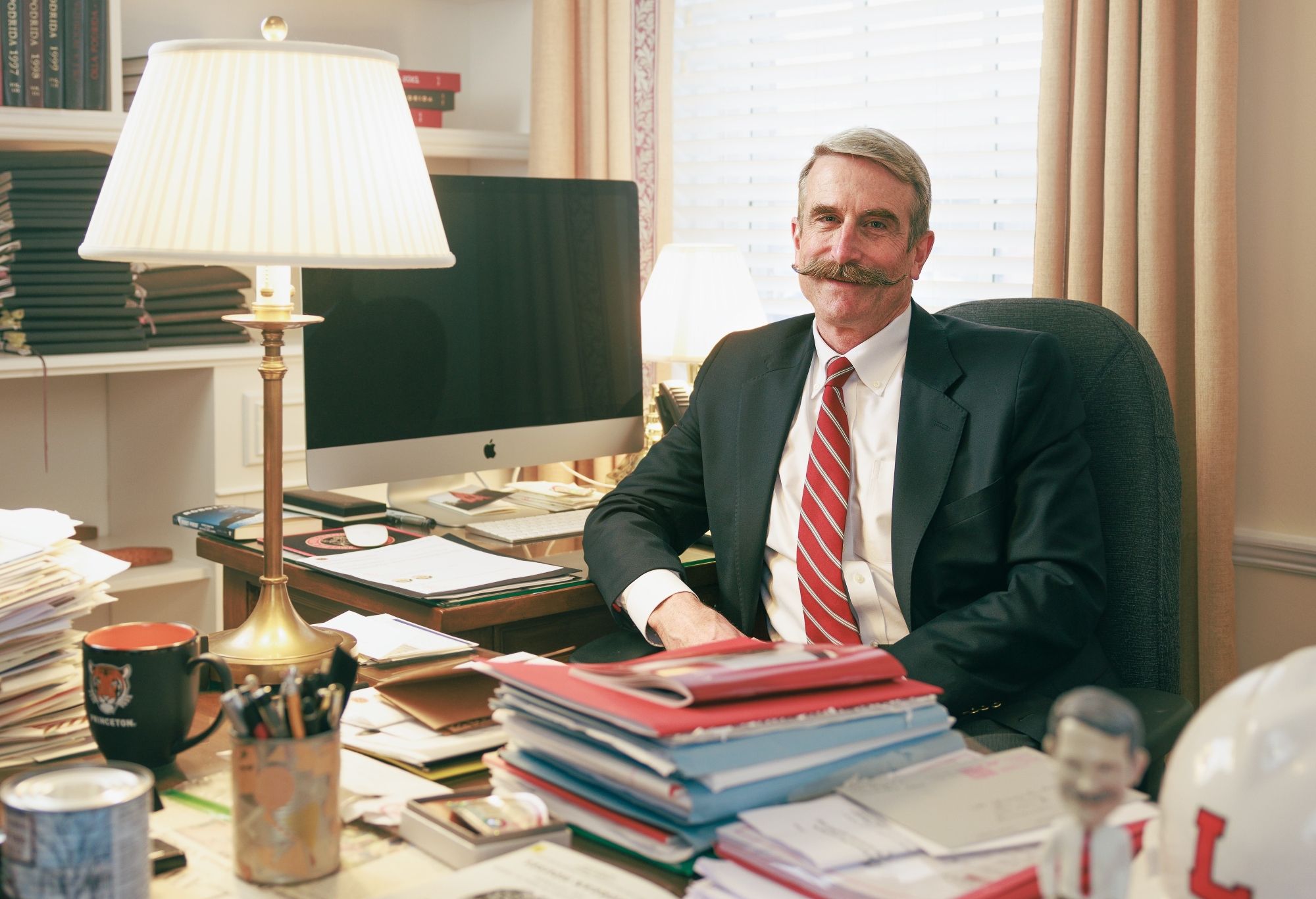
Murray’s desk in his Mackenzie Administration Building office tells a story about his Lawrenceville experience. It is covered with books, papers, and reports, as well as personal and School-related mementos.
The Lawrentian: So, when you look ahead, what sorts of adaptations can you imagine?
Murray: I’ve been encouraging the Board of Trustees recently to take a 30-year view of change and evolution at the School, asking, “What are the things that you really need to be looking at beyond the horizon?” And I framed it around three questions. One is: What are the kinds of things that are core to the Lawrenceville experience that mustn’t change and how we deliver them mustn’t change? And those might be the relational teaching, built on trust and care around a Harkness table, we need to deliver on that as core to the Lawrenceville experience. And the way we deliver it — in person around a Harkness table — shouldn’t change.
The second question is: What are the kinds of things that must endure, but how we deliver them might change? So, if you think about traditional rigor and high aspirations for academic achievement, while AI is dramatically changing how we assess students, how we communicate, what are vital skill sets and what are less vital skill sets? That’s rapidly evolving. And so, it may be that how we define rigor and how we deliver rigor will be different. Asking a great question will become all the more important, and having it be the result of rigorous analysis and thought may even more important. Writing a lengthy creative computer program might be less important, because maybe AI can do that better.
And the third question is: What are the kinds of things that can or should change? And that might include the financial model of the School; should we try to rethink our reliance on the endowment? Transitioning from that could take a few decades. Is the size of the School right? The mix of day students and boarding students — do we have that right? Those things need time to evolve.
My goal is to offer steady, unwavering leadership, and I think it’s all the more important as things are rapidly changing.
The Lawrentian: Advances in technology so often influence changes in behavior. You’ve said when you and Sarah were moving here from Ohio, you came across boxes of old letters you had written to each other as students, which you saved because you both considered them to be important. With so much of what today’s student do existing solely in digital spaces, do you think they miss out on creating these sorts of tangible artifacts that animate personal histories, things they will be able to look back upon to make sense of it all? Or have things like this simply taken different forms?
Murray: I think both are true, in a way. In other words, I think certain tangible artifacts will take on an even greater importance because they will become more of a rarity. An athletic letter from a team, a baseball cap, various things that I think will still be tangible artifacts of their time will be that much more treasured.
I think the digital culture and things like social media are a real challenge to this generation, but at the same time, they will have a much more complete and thoughtful archive of, for example, digital photographs that almost can be a digital journal of sorts. Back in the day, people kept handwritten journals. I have a number myself from my younger days. And as you say, I’m a collector of letters. My wife and I, during times that we weren’t together, corresponded and we saved those letters. I teach a whole French course on the tangible nature — the intimate nature — of a written exchange between two people. And yet, they’ll have a different version of that.
Once upon a time, human culture, human civilization, was more built around oral traditions. The mark of a learned person was someone who could memorize prodigious amounts of information. That’s why The Odyssey is written in rhythmic rhyming schemes. And once paper and writing and printing became fairly ubiquitous, it at first seemed a bit of a shortcut: People will lose the rigor of a mind that can memorize prodigious amounts. But no one thinks of a book these days as a shortcut. They think of it as a rigorous exercise of thinking.
The Lawrentian: That’s a great point.
Murray: With the digital age and AI, I think we’re at one of those moments of transition, where right now, we’re worried that AI represents a lot of shortcuts, which I agree is challenging, to rethink the very act of writing. I still believe students need to exercise their own voice in their writing and critical thinking. But things are changing, and my optimistic self believes that what will emerge is a new version of what rigor and deep thinking look like.
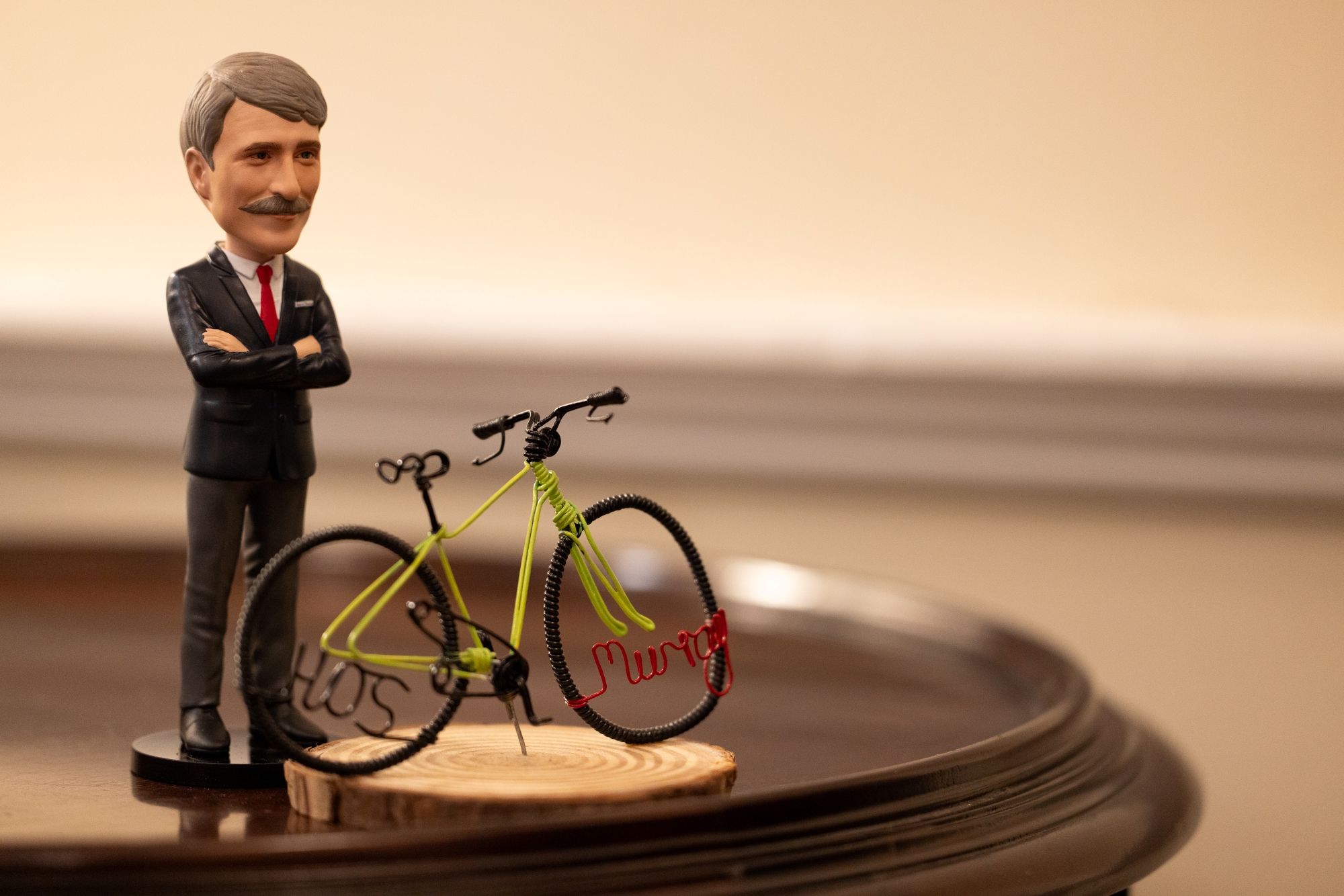
Outside of Murray’s office, just before the desk of his assistant, Maria Mangione, sits this lifelike figurine of Murray and his preferred mode of campus transportation: his yellow bicycle.

On Murray’s desk, this hockey puck doubles as a triumphant paper weight atop a stack of correspondence. The puck is inscribed with the result of a big December 2022 game: “L’ville 1, Hill 0.”

Two stacks of black notebooks, straining to contain additional papers stuffed inside, provide an account of Murray’s ten-plus years at Lawrenceville.
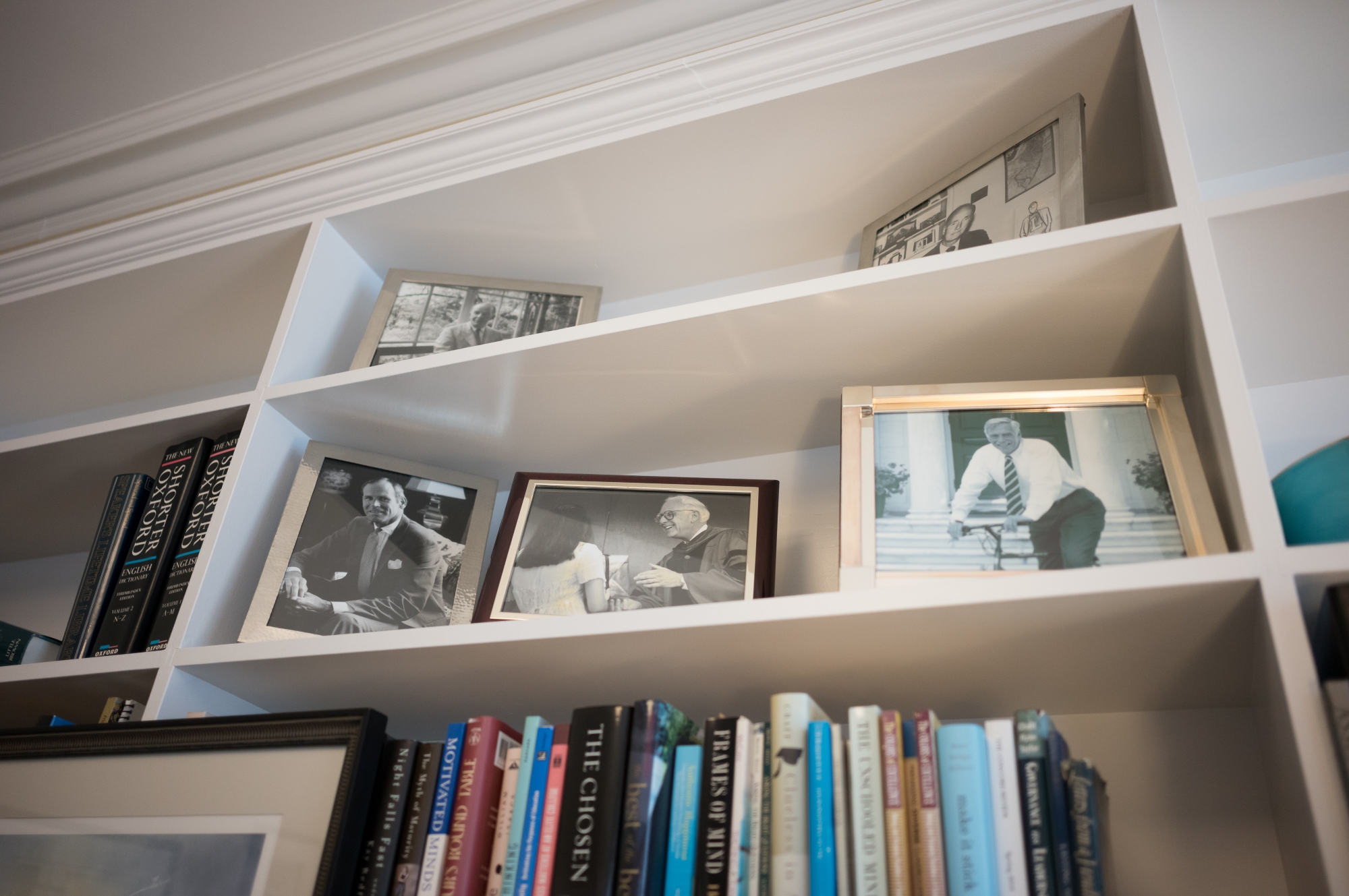
At times when Murray feels the weight of his job, he can cast his glance upward toward his bookcase, where small framed photos of several of his predecessors sit, and be reassured that they would understand.
The Lawrentian: Finally, there was a long-standing tradition of outgoing U.S. presidents leaving a note of advice for their successors on the desk in the Oval Office. Now, to be very clear, you have not made any public indication that you are winding down your time at Lawrenceville, but if you were to leave such a note for your successor, what might you say? [Note: This interview was conducted prior to Murray’s announcement that he would step down in 2027.]
Murray: I’d say “keep the faith” would be one thing. And I think part of my faith comes from a deep belief in the importance of what we do here. I sometimes illustrate that by telling stories. I collect stories about what I see and observe around campus that remind me, and I tell these stories to parents and alums to help them understand that what we believe deeply in at Lawrenceville is alive and well.
For example, I was in a U.S. history class not long ago, and they were studying legal traditions and the judicial branch. And the teacher invited a recently elected state supreme court justice to Zoom in and talk to the students about what she does. One of the first questions from one of the students was, “Well, what is it that you do?” And she said, “Well, it’s interesting. When I was a trial lawyer, I knew exactly what my job was. It was to give my client the most robust, vigorous defense that I possibly could. When I became a circuit court judge, I knew exactly what my job was: to review the facts of a case and examine the laws and statutes, and render a decision that would decide, at least for that day in my courtroom, what the law actually meant.”
And then, she said, “When I became a state supreme court justice, I had to pause, because I found myself sitting in a room with six other very accomplished jurists, and we were all looking at the same basic set of facts and the same basic statutes and, at times, were arriving at completely different conclusions. So, I thought to myself at first, Well, what is my job? Is my job to try to convince them of my perspective and change their thinking? Is my job to dig my heels in and not compromise at all on what I’m thinking and believing?” And she said, “I finally concluded that my job actually was to be curious, and that whether or not I changed my basic position, my understanding would be enriched deeply by pausing to try to understand and be curious about their perspective and to try to work to understand how they arrived at their conclusions, and that really became how I approached my job.”
And so, I, sitting in the classroom and hearing this, said to her, “Your honor, that’s what we do every day around the Harkness table. We encourage our kids to be curious and to enrich and deepen their understanding of something precisely at those moments when they disagree with a peer and examine how their peer is thinking about something.”
And so, it was just a reminder of how important that exercise around the Harkness table is, and how well-prepared, I think, our students are to navigate the world.
* * *
Hear a similar conversation by listening to the latest episode of 18:10 — The Lawrenceville School Podcast, “Discussing a Decade: Steve Murray on Traditions and Transitions.” It is also available by searching on Apple Podcasts or Spotify.