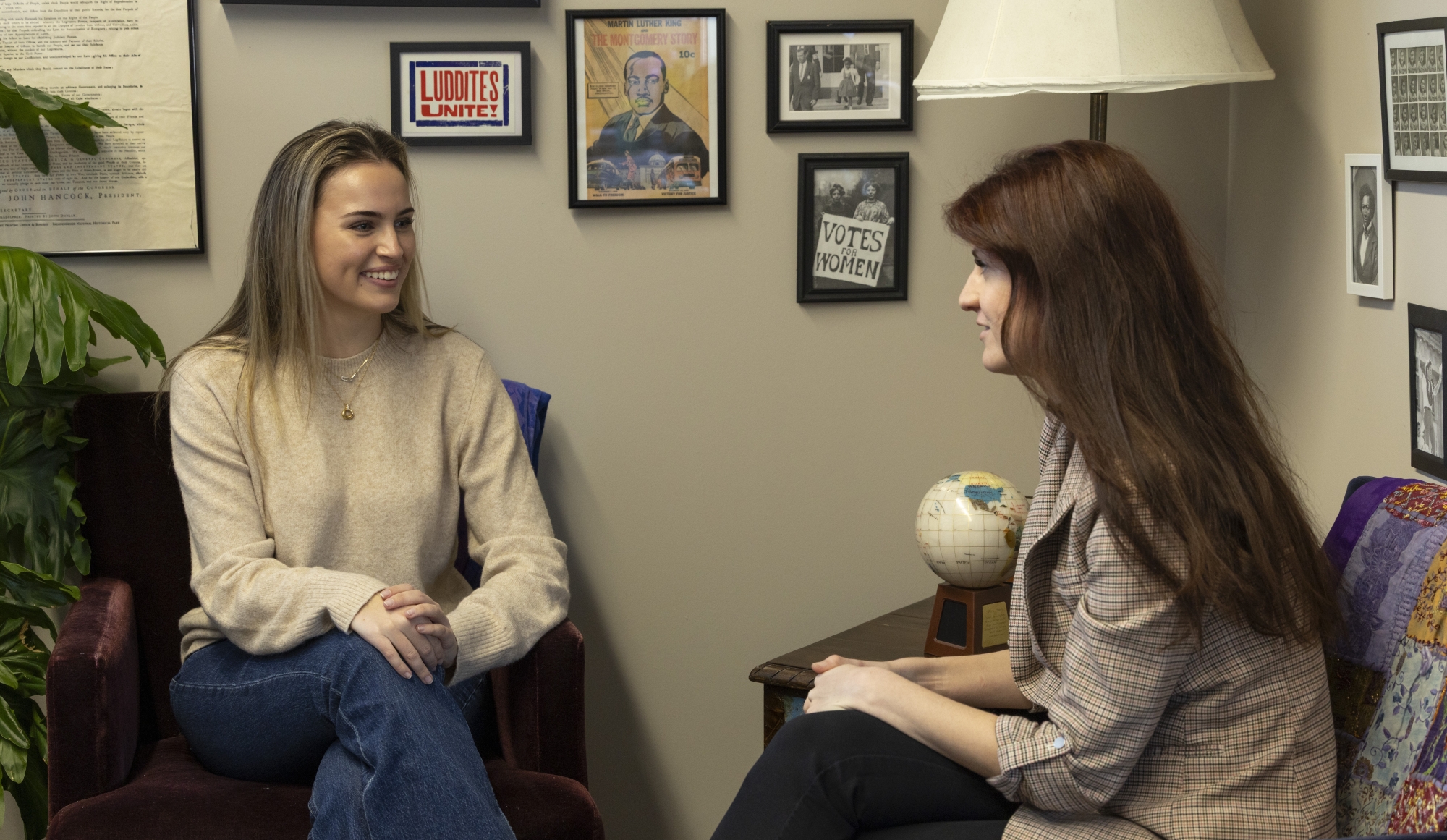
Leila Campbell ’26 (left) transformed her lived experience with stereoblindness into a research initiative, an art-based community workshop, and a broader advocacy effort in Hazel Baldwin-Kress’ Advanced Civic Studies course.
Depth Perception
Lawrenceville’s new Advanced Civic Studies course helped Leila Campbell ’26 — and other students — see community engagement in a new dimension.
“Civics is really all about engagement with one’s community,” history teacher Hazel Baldwin-Kress said. “So, what better way to learn than to actually do it?”
Baldwin-Kress leads Advanced Civic Studies, a new course that reimagines what civic education can look like in practice. Rather than focusing solely on traditional government structures, the class tasks students with designing and executing initiatives that apply civic frameworks to real community needs. Students brainstorm personal connections, assess available resources, and develop projects rooted in access, opportunity, equity, and support.
Leila Campbell ’26 transformed her lived experience with stereoblindness – the inability to perceive three-dimensional depth — into a research initiative, an art-based community workshop, and a broader advocacy effort.
“I thought that it was a really captivating and under-researched topic that wholly encompassed my experience with vision issues and how I was able to cope as a kid,” she said.
With Baldwin-Kress’ guidance, Campbell shaped her idea into a project that connected her passion for art with her interest in visual perception and disability advocacy. Campbell explored how creative expression, medical outreach, and family support can also serve civic goals.
“Nobody makes change by themselves,” Baldwin-Kress said, recalling how Campbell identified her optometrist, Noah Tannen, as a partner who could help connect her work with a broader audience.
The result is a community art workshop for children with vision impairments. The workshop is designed to build confidence, foster peer connection, and challenge limiting assumptions.
“The main point of that is to both create a community,” Campbell said, “and to hopefully inspire in people the knowledge that you can do more than what you’ve been diagnosed with.”
Campbell began her research with a hypothesis rooted in her own artistic experience: “If you can’t see in 3D, if your world is a flat surface,” she explained, “then it’s probably easier for you to translate what you’re seeing onto a 2D canvas.”
Her research extended into art history, uncovering studies suggesting that some Old Master painters may also have been stereoblind — a discovery that validated both her instincts and her creative process.
“That’s what I had been thinking,” she said. “And then when I looked into it, and I found these studies, I was like, I feel like more people should know about this.”
If you can’t see in 3D, if your world is a flat surface, then it’s probably easier for you to translate what you’re seeing onto a 2D canvas.
Campbell’s work has attracted the attention of one of the leading authorities in vision care, Leonard Press, who has asked Campbell and Tannen to co-author an article for the
Optometric Vision Development & Rehabilitation Journal. She hopes the attention will inspire others to use art as therapy for individuals with visual impairments.
“Art has been so beneficial throughout my life,” Campbell said. “Art could be something that you never thought you’d be good at, but, paradoxically, poor vision could actually make you a better artist.”
Campbell’s project is one of many that Baldwin-Kress describes as a “constellation” of civic initiatives — all rooted in different communities and concerns. Other student projects addressed media literacy, access to athletics for female athletes, literacy support for multilingual families, financial barriers to extracurricular participation, and more.
“People think civics is just government,” Baldwin-Kress said. “But it’s also about access, opportunity, community support, and using your own experiences to make meaningful change.”