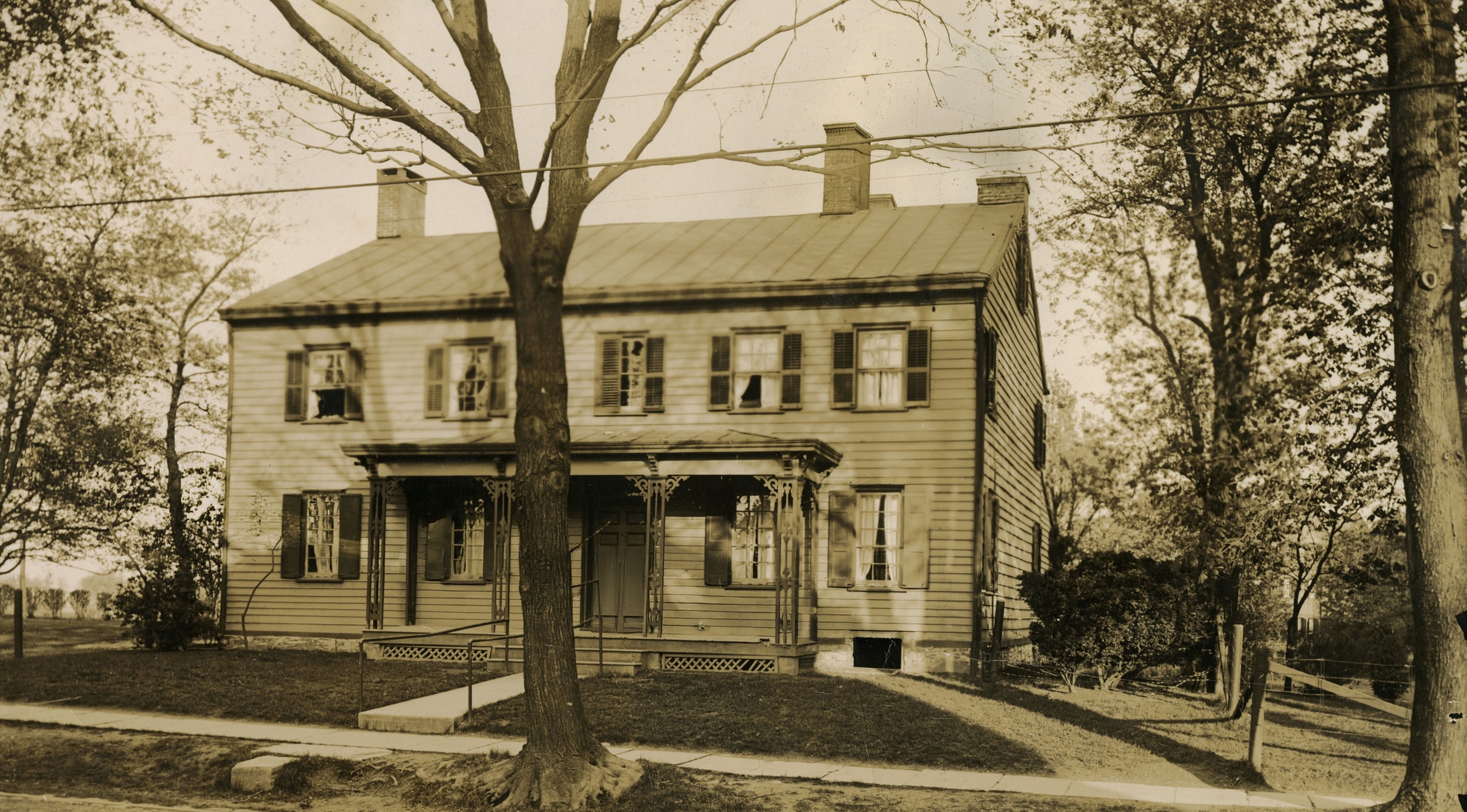
Wayside, located next to Kinnan House, is still in use as a faculty residence.
Built to Adapt
Lawrenceville’s current housing system may seem like a timeless tradition, but since its earliest days, the School has perpetually pivoted in response to the needs of students.

For Lawrentians of a more recent vintage, student housing has followed a smooth and generally orderly pattern: Second Formers reside in either Dawes or Raymond on either side of the Bowl, then advance in the Third and Fourth Forms to either the Circle or Crescent, and finally, as Fifth Formers, move into senior houses on the southern side of campus.
However, this systemized flow approach to housing is a relatively new development in the two centuries of Lawrenceville student life. Alumni who arrived as the School made the shift to coeducation in 1987 also know that housing for students of different grades and genders in those early years was flexible and based on practical needs. Since the School’s founding, students have lived in more than twenty different residences that today are no longer part of their housing system. Some of these older structures remain homes to faculty; another is now a Main Street pizza hotspot. So, while the current configuration seems like a timeless tradition, it’s easy to see from a historical perspective that it merely reflects Lawrenceville’s adaptation to the everchanging needs of its students over time.
The School’s very first boarding students resided with the Rev. Isaac Van Arsdale Brown in his home, where today stands the village post office at the corner of Main Street and Craven Lane. By 1814, the demand for spots at the fledgling academy dictated the construction of what is now Hamill House. Even so, a handful of boys still required housing in the village, although the identities of their hosts are lost to history.
When the John Cleve Green Foundation purchased the School in 1879, its leadership decided to build an entirely new campus, with four new houses for students as well as a new academic building and a home for the new head of school. Even as the new campus construction progressed, the reorganized school opened in the fall of 1883 with 112 students, but with so many eager prospective students, still more space was needed.
The solution? To rent a nearby and recently shuttered school building that had spent the previous half century as the Lawrenceville Female Seminary. The building, north of the current golf course, was designated as Davis House and could hold an additional 25 students.
This did little to stem the tide. By the second year of the new Lawrenceville School and with the rising campus houses still incomplete, the Foundation was forced to rent at least five more local homes to accommodate the swelling enrollment: the Richard Montgomery Green House, Lawrence Cottage (also known as Green Cottage), “Mr. Brearley’s house” and “Mrs. Brearley’s house” (most likely Wayside and a home later known as the Van Dyke house). This also included a location on Main Street known as the “Conover Phalanx,” which abutted a local shop owned by “Auntie” Emma Conover, who sold students the pancakes and waffles immortalized by Owen Johnson, Class of 1895, in his Lawrenceville Stories. By the fall of 1885, the new campus houses — Cleve, Griswold, Woodhull, and Dickinson — were complete and could hold 100 students among them, but with about 40 additional students to accommodate, both Davis and Green House remained in use. Kennedy House joined the Circle in 1889, but the ever-increasing number of students — 226 were enrolled that fall — forced Hamill House to be pressed back into service along with several other local accommodations, and plans to raze Hamill were abandoned.
Lawrentians often remember “their” Lawrenceville as an unchanging place, but in truth, it is always shifting in ways large and small to accommodate the needs of each new generation.
The constant lack of adequate space for students at the rapidly growing School meant that some local abodes became fixtures in the Lawrenceville experience. Davis House would remain active for 56 years before the lease was finally ended in 1930, and the Green House held students for 49 years until 1933. Other houses such as The Lodge, Belknap, and George House, which came into use much later, also served long tenures as student residences: The Lodge for 61 years; Belknap for 27; and George House for 24 before all transitioned to faculty quarters.
Prior to the construction of the Alumni War Memorial Building, or “Old Lower,” as the new Lower School in 1924, it was common practice for the youngest students to be distributed in small groups among the village houses. Older students were given space in large buildings that today’s Lawrentians know well, including Kafer Flats, now the home of TJ’s Pizza & Pasta.
The emergence of Old Lower largely marked the end of smaller, off-campus residences for students, though some, such as Green House, Wayside, and George House, were retained as overflow housing for both Circle and Fifth Form students. Many living Lawrentians can recall their peers living in Wayside, which they did until 1960, Belknap (1973), The Lodge (1975), and George House (1980). With traffic increasing on Main Street in the 1970s, the School consciously decided to ensure all boarding students were housed on campus to minimize crossings of the now-busy road.
Lawrenceville’s decision to introduce coeducation beginning in 1987 created a need for additional beds, now divided by gender as well as grade level. The first four of what are now known as the Crescent Houses were barely enough to accommodate the incoming group of approximately 175 girls. Only Stanley and Stephens Houses held Third and Fourth Form girls; Lower School girls resided in what would eventually become Kirby House, while McClellan House served as the senior girls’ house.
From 1987-90, Lawrenceville attempted several allocations. The Dawes building had served the Lower School since 1972, but from 1987-90, it was temporarily converted into Fifth Form boys’ housing, while McPherson, which had been a senior boys’ House since 1976, became a Fifth Form girls’ House in 1988. Even the addition of Reynolds House in 1988 was not quite enough to hold senior girls, so between 1988-90, they lived in Haskell, Lawrenceville’s second-oldest building. Haskell would again hold senior girls in 2012-13 and 2014-16, with the interim year of 2013 14 acting as an “overflow” house for Fourth Form McClellan girls.
Lawrentians often remember “their” Lawrenceville as an unchanging place, but in truth, it is always shifting in ways large and small to accommodate the needs of each new generation. Fortunately, the strong alumni culture allows Lawrentians of all ages to introduce “their” Lawrenceville to each other through their memories and experiences.
* * *
Jacqueline Haun H’65 is the senior archives librarian in the Stephan Archives in Bunn Library.