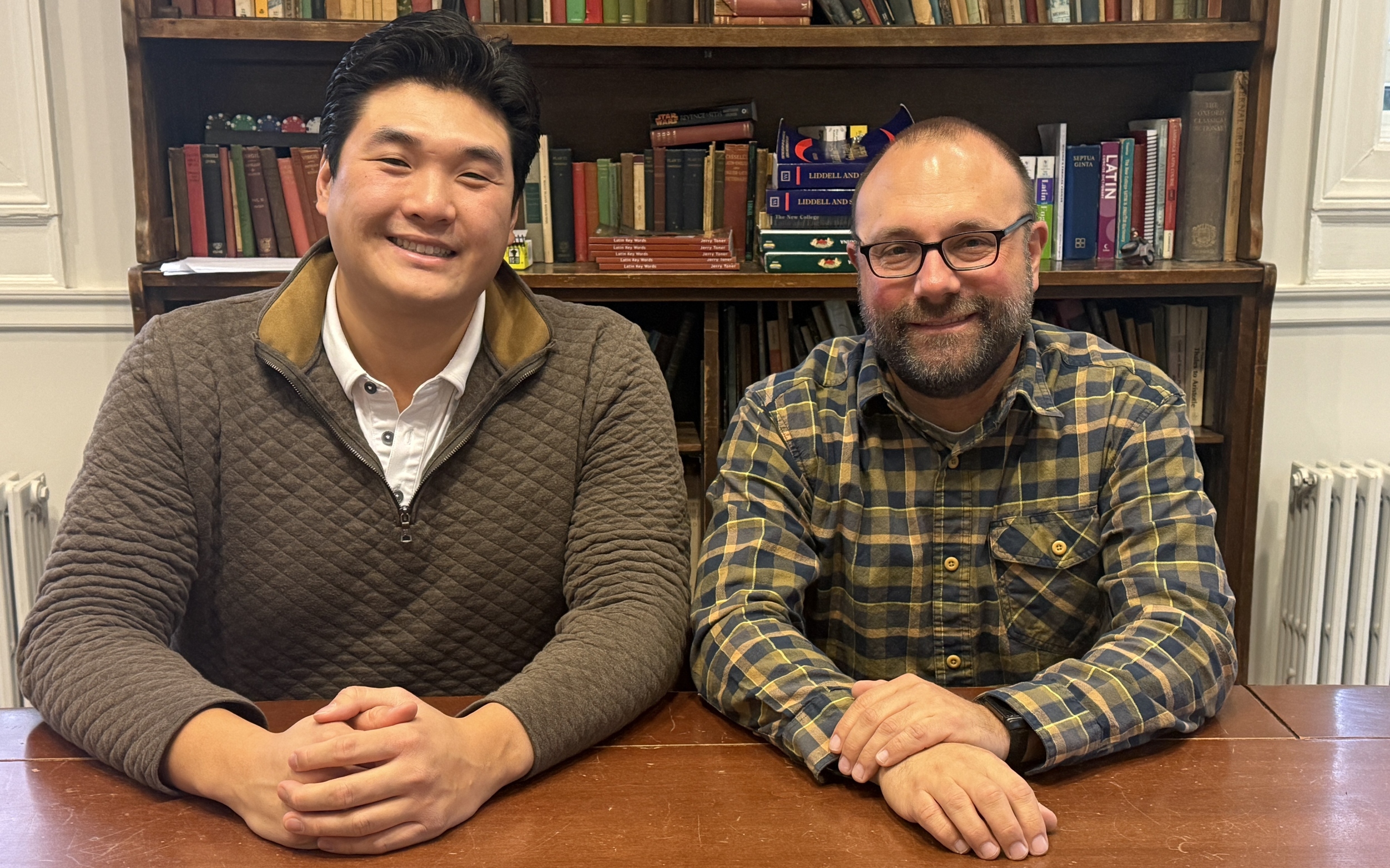
Latin teachers Michael Niu and Scott Barnard completely revamped their foundational Latin classes in order to have students get the most from upper-level Latin classes.
Ancient Words, Modern Minds
By studying a so-called “dead language,” students are breathing life into the way they interpret their contemporary readings. Reports of Latin’s demise are greatly exaggerated.
Why study a language no one speaks? For Lawrenceville’s Latin teachers, the answer lies in the people who once did. Every line of Cicero, every scrap of graffiti, every verse of poetry scratched on a wall is a reminder that the ancients were not strangers, but reflections of ourselves.
“We want to drive home the point that ancient people were not in any way primitive,” says Scott Barnard, who teaches Latin in the Language Department. “They are very similar to modern people. There’s something universally human that we can learn by studying them that helps us better understand ourselves.”
That idea that Latin is a direct conversation with real human voices across 2,000 years sits at the center of Lawrenceville’s Latin program. It’s training students to listen carefully, think critically, and recognize themselves in someone else’s world.
“It’s also about giving students the tools to experience that for themselves and not have to rely on the filter of a translator,” Barnard says. “We want them to see what was actually on these people’s minds.”
For fellow Latin teacher Michael Niu, the program is just as much about the present tense.
“Your choice of words and how you express yourself and how you communicate with people often leaves a first impression,” Niu says. “Learning Latin teaches students the importance of words and how they can articulate themselves.”
Three years ago, Barnard and Niu hit a wall with traditional Latin textbooks, which, they believed, did not emphasize the relevance of the subject. So, with support from a Lawrenceville Woods Summer Research Grant, a program named in honor of former English teacher Henry C. Woods ’40 and supported by a gift from his estate, the pair wrote their own curriculum, spending two summers building Lawrenceville’s Latin I and II texts from scratch.
“We asked, What do we want the Latin I and II experience to be so that they can get the most out of Latin III, when we start to read real Roman authors?” Barnard says. “We designed a program that teaches things in the order and with the depth that we think are really necessary for a high school student. We examine authors who will actually resonate with our students. We’d rather have them thinking about what it means to be a young person in a complicated world than sprinting through an exam rubric.”
There’s something universally human that we can learn by studying them that helps us better understand ourselves.
For Bridget Holden ’26, exploring Cicero’s rhetoric revealed how relevant Latin remains today. As she researched Cicero’s orations, she noticed parallels between ancient rhetoric and modern political speech.
“It really is fascinating to me how modern politicians still arrange their persuasive arguments with ancient constructions,” she explains, “and only replace old language with contemporary diction that’s suited for current audiences.”
Holden also believes the class has changed how she approaches information itself.
“It made me think about why I believe what I believe. When reading the news, how many of the conclusions I’ve come to are actually my own?” she wonders. “Is the information I read precisely factual, or is it presented with strategic language that intentionally guides readers to a predetermined conclusion? It’s impacted a lot of the way I think every day.”
Everything Old Is New Again
Students are seeing their lives with the writings of the ancients.
“The classroom is always filled with laughter, and the enjoyment of one another’s company is always apparent. The environment fosters healthy learning and makes class more enjoyable.”
Noah Mondello ’27
“There have been moments when I think a poem could be translated one way, but my friend might think something else [since Latin doesn’t always have a contextual translation]. Those always lead to great discussions, trying to uncover the author’s intent, and they’re always a lot of fun.”
Marco Pellegrini ’26
“The first thing that comes to mind is how my perception of language has changed. It might be natural to assume that systems and cultures from thousands of years ago would likely have little in common with modernity, but looking into Cicero has proved to me that few parts of our world are entirely novel.”
Bridget Holden ’26
“Once we get into Latin III and Honors Latin, class becomes much more Harkness. We’re interpreting what we’re reading. There’s less ‘this is the form and this is what it means,’ and more ‘here’s the range of what this could mean; what do you think is most accurate and why?’”
Scott Barnard, Latin teacher