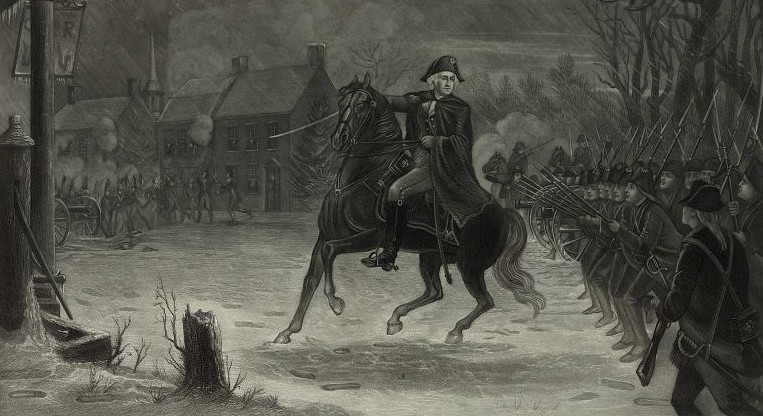
Gen. George Washington led his ragtag band of soldiers against Hessian troops at the Battle of Trenton, which began to turn momentum toward the American side.
At the Crossroads
As the United States celebrates the semiquincentennial of its independence, we look back on the role the tiny village of Maidenhead — today’s Lawrenceville — played in the struggle.

The Lawrenceville School’s founding date of 1810 precludes any direct involvement in the establishment of American independence, the 250th anniversary of which is being celebrated this year. However, the School is nestled geographically in the very heart of perhaps the most significant series of clashes in the Revolutionary War, between the Battles of Trenton and Princeton, which turned the tide for a nascent America after a year of repeated defeats.
In 1776, the village of Lawrenceville was still known by the name given by the Quakers — Maidenhead Township — after the first settlers arrived around 1680. It was a sleepy little farm village, with nothing much to show outsiders beyond its Presbyterian Church, located then as now, adjacent to
the School on today’s Main Street, as well as a handful of taverns, inns, and local farms. Despite its small size and lack of many amenities, Maidenhead was conveniently located on the King’s Highway, a major stagecoach and postal route between Philadelphia and New York. This would ultimately place it in the path of both British and American troops.
The American Revolution had officially begun with the shots fired on April 19, 1775, in Lexington and Concord in Massachusetts. By July 4, 1776, representatives from the thirteen colonies had gathered as the Second Continental Congress in Philadelphia and signed an official Declaration of Independence from the mother country, marking the official start of the United States of America.
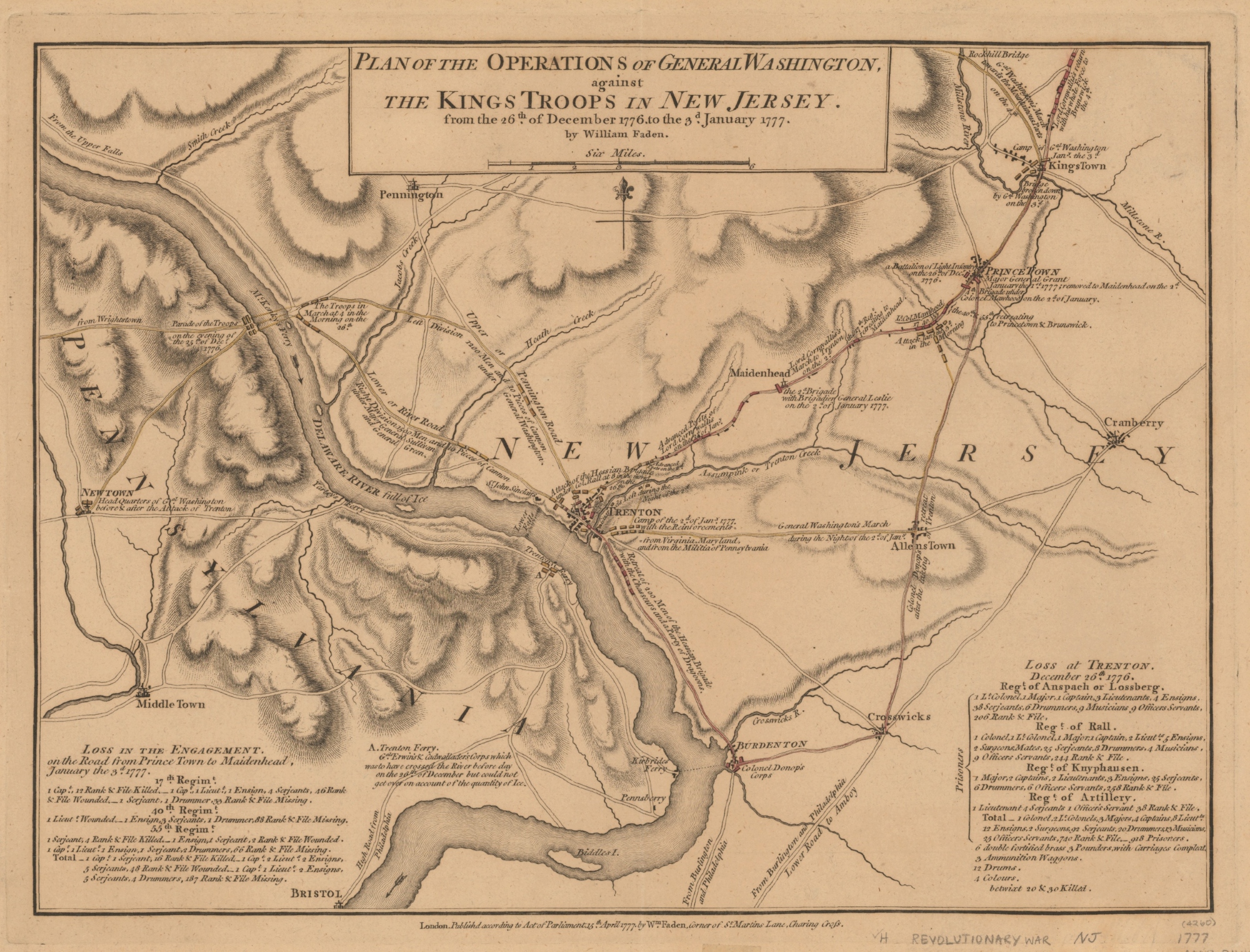
This 1777 map shows the sites of Gen. George Washington’s battles with British troops over the “Ten Crucial Days” from December 26, 1776, and January 3, 1777. Note the key location of “Maidenhead” — today’s Lawrenceville — halfway between Trenton and Princeton.
However ambitious the start, the fight for American independence was struggling by December 1776. The American Continental Army had suffered many defeats over the previous year and a half of fighting, including the loss of New York to the British. The agreed-upon enlistment periods for many of the American soldiers were also soon expiring that winter, and Gen. George Washington feared that many discouraged soldiers would give up the fight as a lost cause and return home. As winter loomed, Washington and his troops had withdrawn from New Jersey, across the Delaware River into Bucks County, Pa., where they were in desperate need not only of supplies but, imperative for the sake of morale, some sort of inspirational win.
The opportunity came in late December. The British were trying to prevent further American incursions into New Jersey by maintaining control of locations along the King’s Highway as a main north-south supply route. About 1,500 Hessian soldiers from Germany, hired by the British as auxiliary troops, had arrived in mid-December to set up their winter camp in Trenton, then a small but commercially vital town of about 100 households located on a bend of the Delaware River about six miles south of Maidenhead. Washington and his commanders devised a plan to attack the Trenton outpost on December 26 and seize the Hessians’ ammunition and food supplies by using a three-pronged strategy that would strike across the Delaware River from the north and the south.
Although the attack did not go at all as planned — severe weather slowed down Washington’s midnight crossing of the Delaware and impeded the other two units from mounting their supporting attacks — Washington and his troops succeeded in taking Trenton from the Hessians, who were caught off guard following their Christmas celebrations. Washington seized not only the targeted supplies but also captured approximately two-thirds of the Hessian troops, the rest having fled or been killed.
Following the successful Battle of Trenton, Washington expected that the British would mount a strong counterattack. He decided to place defensive troops outside Trenton along the Assunpink Creek, which made up the southeastern border of Maidenhead before it flowed into Trenton from the north, just east of today’s Brunswick Circle on Business Route 1.
On January 1, 1777, the British took control of Princeton, which was about five miles north of Maidenhead. The next day, Lt. Gen. Charles Cornwallis began to march down the King’s Highway toward Trenton with an additional 9,500 troops, reaching Maidenhead around noon.
As the British troops entered the northern end of the village, they spied a man on horseback, local farmer Elias Hunt, who had just exited the home he and his family were temporarily abandoning to avoid the impending clash. (His home has been identified as what became the recently closed Inn at Glencairn, just north of today’s Carter Road.) Hunt began to flee south toward the location of an American picket — a small unit of soldiers that serves as early warning of and defense against approaching attacks — stationed opposite the Presbyterian Church. He was pursued by a Hessian soldier, also on horseback, who ran far ahead of his British comrades.
As the sword-waving Hessian reached the point between the church and the picket on the other side of the road, an American marksman shot him. The first shot was only a wound, but as the Hessian turned his horse to return to his fellow troops, the marksman fired again, killing both horse and rider. The American soldiers then retreated south ahead of the British to Five Mile Run, where the little Shabakunk Creek crossed the Maidenhead road, at today’s Notre Dame High School. The Hessian soldier was buried in the woods across from the church, on the property of Col. Joseph Phillips.
As the sword-waving Hessian reached the point between the [Lawrenceville Presbyterian] church and the picket on the other side of the road, an American marksman shot him.
This was only the first of multiple encounters between the British and the Americans in Maidenhead that day, for as Cornwallis attempted to continue the march toward Trenton, he met the troops of Col. Edward Hand, an Irish-born physician and soldier who led the 1st Pennsylvania Regiment of the Continental Army. Hand’s units mounted multiple skirmishes along the Maidenhead road, slowing down the advance of the British for many hours. The British made slow progress until they reached the bridge over the Assunpink into Trenton (at the current-day Mill Hill Park), over which the outnumbered Americans had retreated, but after three failed attempts to cross the bridge and with dusk falling, the British were forced to camp for the night at a nearby mill owned by John Phillips.
While the British slept that night along the Assunpink, Washington and his troops, guided by local Maidenhead men, snuck around the British forces and went by back roads to Princeton to attack the British garrison, which was being led by Charles Mawhood. Despite the element of surprise, the Battle of Princeton on January 3 was not an easy one. Gen. Hugh Mercer’s American troops were overrun, and Mercer was mortally wounded. When the British demanded Mercer surrender — mistaking him for Gen. Washington — Mercer declined and was subsequently killed. With the death of their leader, Mercer’s men began to flee.
Complete disaster for the Americans was averted only when Gen. Washington and additional troops arrived and encouraged the Americans to rally once again and push back against the British. Under Washington’s leadership, the American troops drove the British back until Mawhood gave the order to retreat. While many of the British attempted to flee toward Cornwallis in Trenton, others had taken shelter in Princeton’s Nassau Hall. With the surrender of those troops, the Battle of Princeton was considered at an end and a successful one for the Americans.
While the Battle of Trenton, the Battle of the Assunpink, and the Battle of Princeton might be considered relatively small battles, their success significantly turned the tide for the morale of the Americans. The British, having faced three defeats in ten days, evacuated central New Jersey, while Gen. Washington moved his troops north to Morristown for the winter.
Today, Lawrence Township continues to celebrate the successful Revolutionary battles that took place as part of the “Ten Crucial Days” annual re-enactment events in Trenton that trace the footsteps of Washington, the British, and Colonel Hand each December and January.
* * *
Jacqueline Haun H’65 is the senior archives librarian in the Stephan Archives in Bunn Library.