Catching Lightning in a Can
Clement Pappas ’92 and his company’s Surfside went from a novel idea for canned drinks to the fastest-growing alcohol brand in the world seemingly overnight.

It’s time for summer, and all the fun that comes with it, whether at the beach or the ballgame. But that sun is strong, and it gets hot out there, building a thirst in you that demands to be quenched. Keep an eye open, and you’ll likely see someone pop the tab on a cold Surfside. You might even be the one doing it. And you wouldn’t be alone.
The ready-to-drink cocktails — with colorful sunset stripes ringing cans filled with refreshing, non-carbonated iced tea-with-vodka and lemonade-with-vodka flavors — seem to be everywhere. Since its launch in 2022, Surfside has become a sensation, driven by explosive case growth that saw sales climb from 200,000 that first year to 4.9 million in 2024, to 11.1 million last year. Surfside’s parent company, Philadelphia-based Stateside Brands, projects sales of a whopping 16 to 17 million cases this year.
It was the No. 1 top growth spirits brand worldwide from 2022-24, according to IMPACT Data Bank, which is just an industry way of saying that Surfside went from a brand-new canned drink to the world’s fastest-growing alcohol brand almost overnight.
It’s all put a giant smile on the face of CEO and co-founder Clement Pappas ’92, who is just a bit bemused at the way Surfside has seemingly captured lightning in a bottle … or at least in a can.
“I mean, listen, we obviously had our reasons [to develop Surfside], and thought it was a good idea,” says Pappas, known to most as “Clem.” “But certainly, the magnitude of the success is definitely not something I would’ve predicted if you had asked me going in.”
Pappas and his co-founders, brother Zach Pappas and another set of brothers, Matt and Bryan Quigley, were not novices to the spirits and beverages game. Clem Pappas came up in the family business that, by the time he became an executive, was producing private-label juice for large brands such as Apple & Eve and Welch’s. After his father, Peter Pappas P’92 ’97, died in 2010, the family voted to sell the company, a move Clem opposed.
“I was not thrilled about it, because I always loved that business,” he says. “I always thought I would work there. But I was kind of like, OK, what’s next?”
After a mutual friend planted a copy of the Quigley brothers’ business plan in the powder room at Pappas’ 40th birthday party in 2014, he read it, and days later, met Matt Quigley. Together, they founded Stateside Urbancraft Vodka in 2015, and it quickly became a favorite in Philadelphia taverns. It remains what Pappas calls “really a regional brand,” but the spirit is a recognizable call to bartenders throughout the area.
Pappas says the Stateside brand caught some wind in its sails during the first year of the COVID-19 pandemic, when Pennsylvania Gov. Tom Wolf temporarily closed the state-operated wine and spirits stores. They were deemed “non-essential,” but Pennsylvania permitted in-state distilleries to continue producing and selling their spirits direct to the consumer, particularly though home delivery.
[T]he magnitude of the success is definitely not something I would’ve predicted if you had asked me going in.
“Almost like a pizza delivery boy, we were allowed to deliver vodka, so, when they closed all the liquor stores, we went bananas,” he says, noting that he and his partners originally anticipated laying off its employees. “We wound up doubling our business overnight, and we woke up from the fog. I mean, it was crazy.”
Not only did Stateside retain every one of its employees, but they all went into overdrive.
“We were distilling around the clock. Matt was distilling at night. We had 23 or 24 people running around in cars delivering vodka,” Pappas recounts. “By the time they reopened the liquor stores and things calmed down with that, we looked and we had a million dollars in the bank account. I was like,
Holy shit, we’ve got some real money.”
That bulging balance enabled Stateside to back some new ideas. By 2021, ready-to-drink canned cocktails like White Claw Hard Seltzer and High Noon had become increasingly popular as low-calorie alternatives to light beer. Pappas and Stateside developed Stateside Vodka Soda, which, like High Noon, uses the clear spirit as its base (White Claw is a malt-based hard seltzer). Stateside Vodka Soda quickly became popular in the Philadelphia market, buoyed by the good will it had built with consumers during the pandemic, “but we were late to the party in the rest of the country,” Pappas says. “All the distributors and all the stores, the big chain retailers, just said, ‘Ah, we’ve got enough vodka sodas. We don’t want to carry any more.”
At the same time, however, Stateside continued innovating. Pappas and others around Stateside’s headquarters had been wearing 1970s-style, surf-themed gear, with its iconic stylized sunset stripes. The style, and the mood it stimulated, got them thinking.
“Matt just had this idea, like, ‘Hey, I want to put that on a can, and it’d be great with iced tea,’” Pappas says. “And then ultimately, we came out with lemonades and other flavors as well. We launched Surfside as … not a pet project, but just something Matt really was passionate about. It just took on a life of its own.”
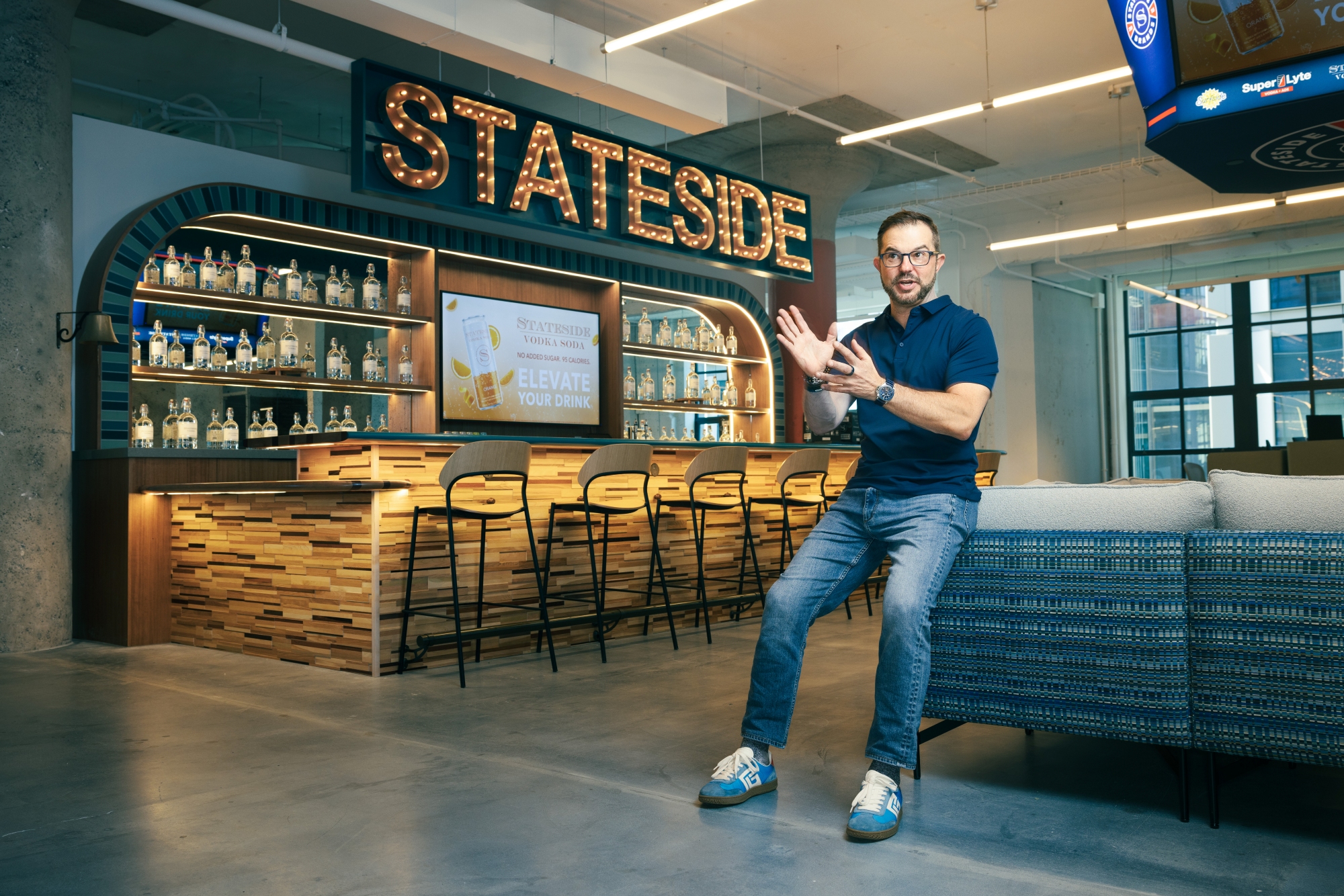
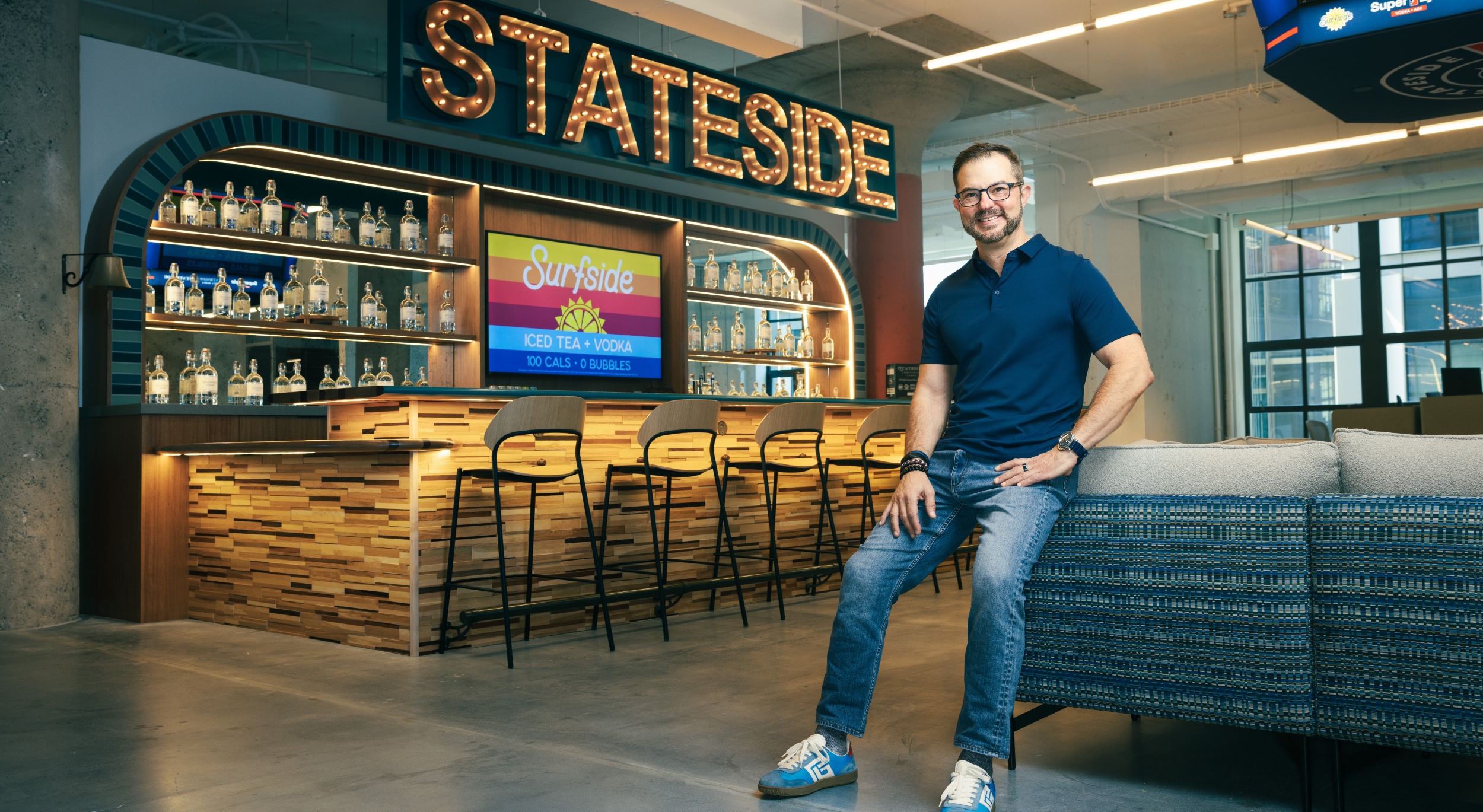
Pappas at Stateside’s new Center City headquarters in Philadelphia. Though Surfside is huge coast to coast, Stateside Brands remains an integral part of the commercial and recreation culture of its hometown.
Surfside immediately became a sensation at Citizens Bank Park, home of Major League Baseball’s Philadelphia Phillies, and at the Jersey Shore. At the ballpark, roaming beer vendors — “hawkers,” in ballpark parlance — began experimenting with Surfside, and soon the drink was outpacing stadium stalwarts Miller Lite and Michelob Ultra.
“Pretty soon, by June or July, every hawker in the stadium started carrying Surfside,” Pappas says, “and we became the No. 1 seller in the whole stadium.”
Stateside Brands negotiated a modest deal to sell Surfside there only after pitching the uniqueness of the product.
“We were really the first ones to be non-carbonated in that spirit-based space,” he says. Pappas allows that Twisted Tea, which has been on the market for 30 years, is also non-carbonated, but its high sugar content — 30 grams per bottle — and malty heaviness make it a noncomparable in the ready-to-drink market.
“That’s the other thing with ours: It’s clean. It’s 100 calories, it’s zero carbonation, it’s two grams of sugar,” he says. “So, it doesn’t feel heavy. You can drink it, it tastes good. It tastes like iced tea. It doesn’t have a funky malt aftertaste.”
This emerging preference for “lighter” is another wave Pappas hopes to catch with the recent introduction of Super Lyte, a canned vodka-based beverage inspired by sports drinks.
“If you look at the sports drink category, Gatorade and those kinds of brands, they have huge household penetration,” he says. “It’s pushing 90 percent. I mean, almost everybody has Gatorade. It doesn’t demand a lot of you. They’re just easy flavors.”
By late June, Super Lyte was performing at levels that mimic Surfside’s early days.
“We’re more lined up with our supply chain than we were when Surfside first came out,” Pappas says, “but, I mean, it’s only been out about a hundred days, and we’ve already sold over 500,000 cases.”
For now, though, Surfside remains on full throttle, with Pappas mindful of the big beverage corporations horning in on his business.
“Because we know that once the market sees that there’s something out here working, you’ll get a lot of copycats or fast followers,” Pappas explains. “And then pretty quickly, the big guys will be able to muscle you out if you don’t mark some territory, so we’ve been on an absolute sprint for four or five years now.”
To that end, Surfside’s lead in the category seems strong, and it has enabled Stateside Brands to expand its footprint across the country. Surfside has been the best-selling spirits brand at Citizens Bank Park since 2023,but it is also involved in partnerships with some70 professional and collegiate teams, including 16 Major League Baseball stadiums.
Closer to home, the parent company last year secured naming rights to the former Xfinity Live!, the wildly popular 10-acre entertainment and sports viewing compound located in the heart of the Philadelphia sports complex on the site of the long-gone Spectrum. Now, thirsty Phillies, Eagles, Flyers, and 76ers fans flock to Stateside Live! year-round for a more complete pre- and postgame experience. For an area native and Philly sports fan like Pappas, it’s like a dream come true.
“I was there a couple weeks ago,” he says. “I was just looking at this, thinking, ‘God bless America, man. This is unbelievable.’”