Windows to the Soul
After nearly 130 years, the historic and beautiful Tiffany windows of Edith Memorial Chapel are in need of conservation.

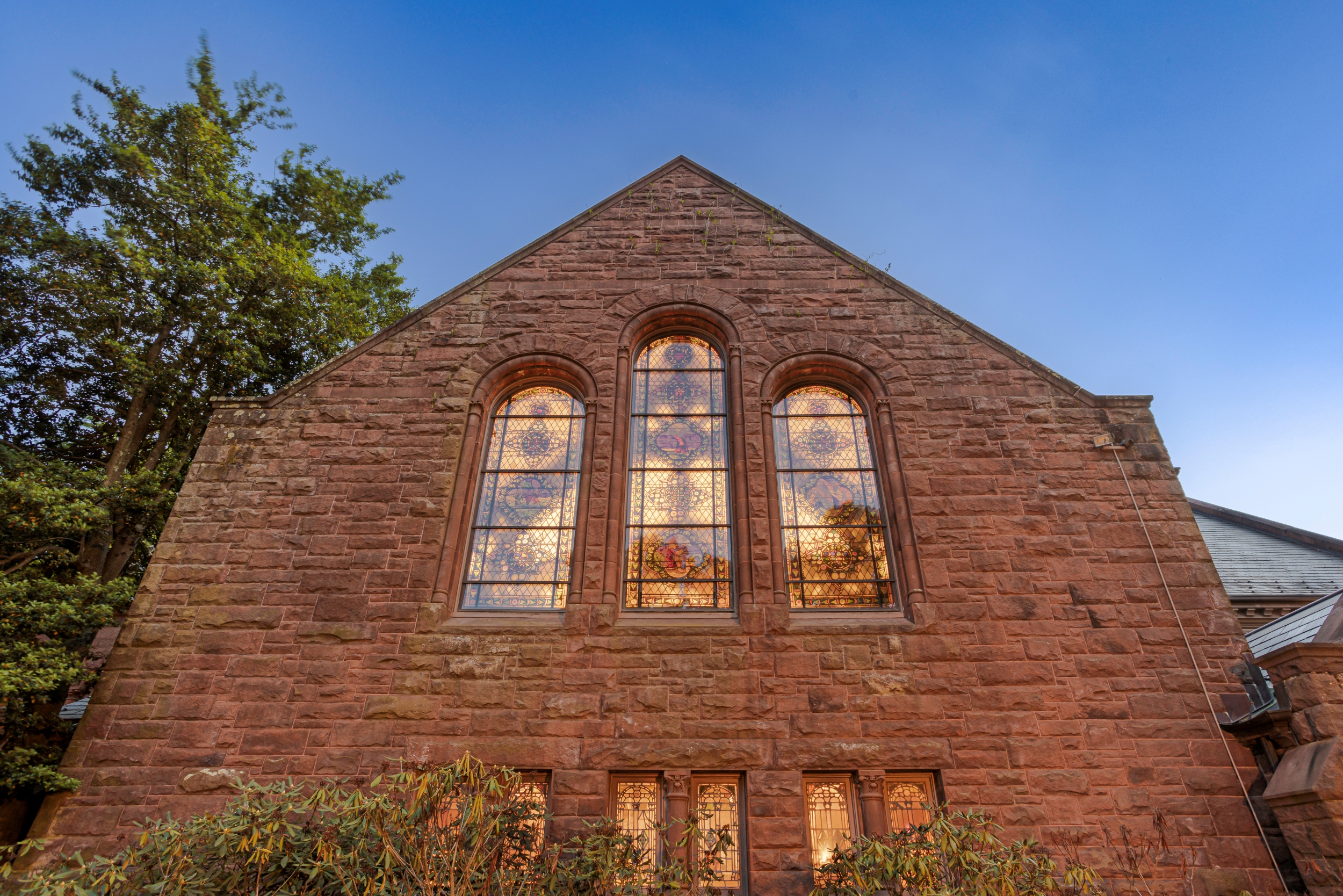
When it was completed in 1895, Edith Memorial Chapel became the last structure built on Frederick Law Olmsted’s famous asymmetrical Circle. The Chapel, constructed during America’s Religious Building Boom (1877-1900), epitomizes the Auditorium Protestant Church style with tiered theatrical seating and leaded-glass windows showcasing biblical scenes and ornate patterns. Fourteen of the windows girdling Edith Memorial Chapel were created by Tiffany Glass and Decorating Co., founded by Louis Comfort Tiffany.
Six of these are exceptionally rare and large Medieval Medallion-style windows featuring biblical scenes and vast swaths of opalescent glass. The remaining eight windows are small Ornamental-style works filled with Christian symbolism and jewel-toned colored glass. They are historically significant and beautiful.
They are also, as one might expect given their age, in need of repair.
On a visit to Lawrenceville in early 2017, Lindsy Parrott, the executive director and curator of the Neustadt Collection of Tiffany Glass in New York, and Morgan Albahary ’10, then the Neustadt’s curatorial and collections associate, spotted a phenomenon known as “deflection” in the Medieval Medallion windows.
Deflection is the bowing and bending of lead lines from unregulated temperatures. The surface of the windows rippled like ocean waves, cresting and receding. If left untreated, deflection can result in window collapse, because lead lines expand beyond their ability to support individual pieces of glass.
Parrott recommended I reach out to Femenella & Associates, one of the nation’s foremost experts in the care and restoration of historic glass. That spring, we received a visit from its founder, Art Femenella Sr., who had just signed a deal to work on the leaded glass in the U.S. Capitol, to introduce him to the Chapel and its glass.
“What’s the verdict, Art?” I asked Femenella, who towered above me in the Chapel’s crossing as he examined the antique glasswork. “Will we be able to repair the windows?”
His expression suggested concern. “Deflection can be repaired,” he advised me afterward, “but we spotted more underlying issues.”
Femenella returned to campus in March 2019 to conduct a closer, detailed assessment of the windows’ condition. Generously funded by Leslie P’09 ’11 ’14 and Bob Doll P’09 ’11 ’14 and family, this essential assessment was to determine the state of the Chapel’s windows after nearly one-hundred thirty years, and potential treatments.
Soon, it became evident that although periodic efforts to maintain them had extended the natural life of the Tiffany windows, the continuous effects of time and the irresistible dynamics of separating the indoors from the outdoors had also pushed them to a point that now required a more dramatic intervention. My research informed me that the windows had been previously releaded and reinforced with metal bars in 1950, according to an account in The Lawrence, though I have been unable to locate any additional records of that work. Glazing had been added as a protective layer in the late 1970s or early 1980s, but again, the associated paperwork is sparse. Femenella believed that the Medieval Medallion windows may have evinced deflection in the past and that part of the prior restoration attempt consisted of flattening the windows.
“Doing so often causes glass to crack,” he told me, “and you have numerous areas of cracked glass.”
In his estimation, workers tried to cover some breakage with “Dutchman lines,” or faux lead lines, which altered the window’s original appearance.
Our best course of action would be to remove the windows, place them into climate-controlled storage, and temporarily replace them with high-quality replicas until the originals were conserved.
Femenella also found that the 1968 reconfiguration of the Chapel’s apse to accommodate the new organ and pipes had necessitated the flattening of the Ornamental windows in order to fit them into their new space. Some of the windows were also slightly askew within their frames, and with forty plus years of unvented glazing, Femenella said, there was a high probability that the windows’ wooden frames were rotting due to moisture trapped between the glazing and the windows.
“Unvented glazing would also account for the obvious deflection,” he explained. “That space between the windows and glazing has become a super-heated microclimate.”
Leaded glass is designed to flex with wind loads. However, over long periods, the metal fatigues from constant movement and eventually breaks.
The Chapel windows had broken solder joints and cracks in the lead cames – the joints that connect pieces of stained glass – throughout the windows. Femenella also noticed the cames had corroded, and that the windows would need to be completely releaded. What’s more, typical of depictions of human figures in Tiffany’s portfolio, the faces, hands, and feet painted on the glass in the Chapel’s windows had flaked off from those areas, diminishing the original images.
“It can all be conserved, Sarah,” Femenella reassured me. “And I’m here to help.”
Lawrenceville’s development officers began working with School administration and trustees to formulate a plan to fund conservation. But with the sudden onset of the pandemic in March 2020, applicable budgets were diverted to cope with COVID-19, including the pivot to distance learning, and the project was paused for a time. In November 2021, I began discussing emergency stabilization options with Femenella and his son, Art Femenella Jr., whose knowledge of welding expanded the family business to include the restoration and conservation of steel and metal windows.
We determined that our best course of action would be to remove the windows, place them into climate-controlled storage, and temporarily replace them with high-quality replicas until the originals were conserved. Removal and treatment would occur in two stages: The Medieval Medallion
windows would be addressed first and the Ornamental windows second. The Tiffany windows were professionally photographed, appraised, and insured for their removal, storage, and conservation.
Femenella & Associates extracted the Medieval Medallion windows in March 2023, removing the glazing and Tiffany’s original work in small rectangular sections. Each section of Tiffany’s windows was secured between thick foam sheets, placed in custom-made wooden crates, and transported to a climate-controlled storage space. Once the original windows were removed, temporary replicas – with a lifespan of three years – were installed. Over the span of three weeks, the Tiffany Medieval Medallion windows were protected from further deterioration.
I, along with my colleagues, look forward to the project’s next phases.
* * *
Sarah Mezzino is the curator of decorative arts and design for the Stephan Archives.
A version of this story appeared in the Fall/Winter 2023 issue of The Lawrentian. The conservation of the Tiffany windows has been completed with the generous support of the Mario Family Foundation. The windows were reinstalled in Edith Memorial Chapel in the spring and summer of 2026.