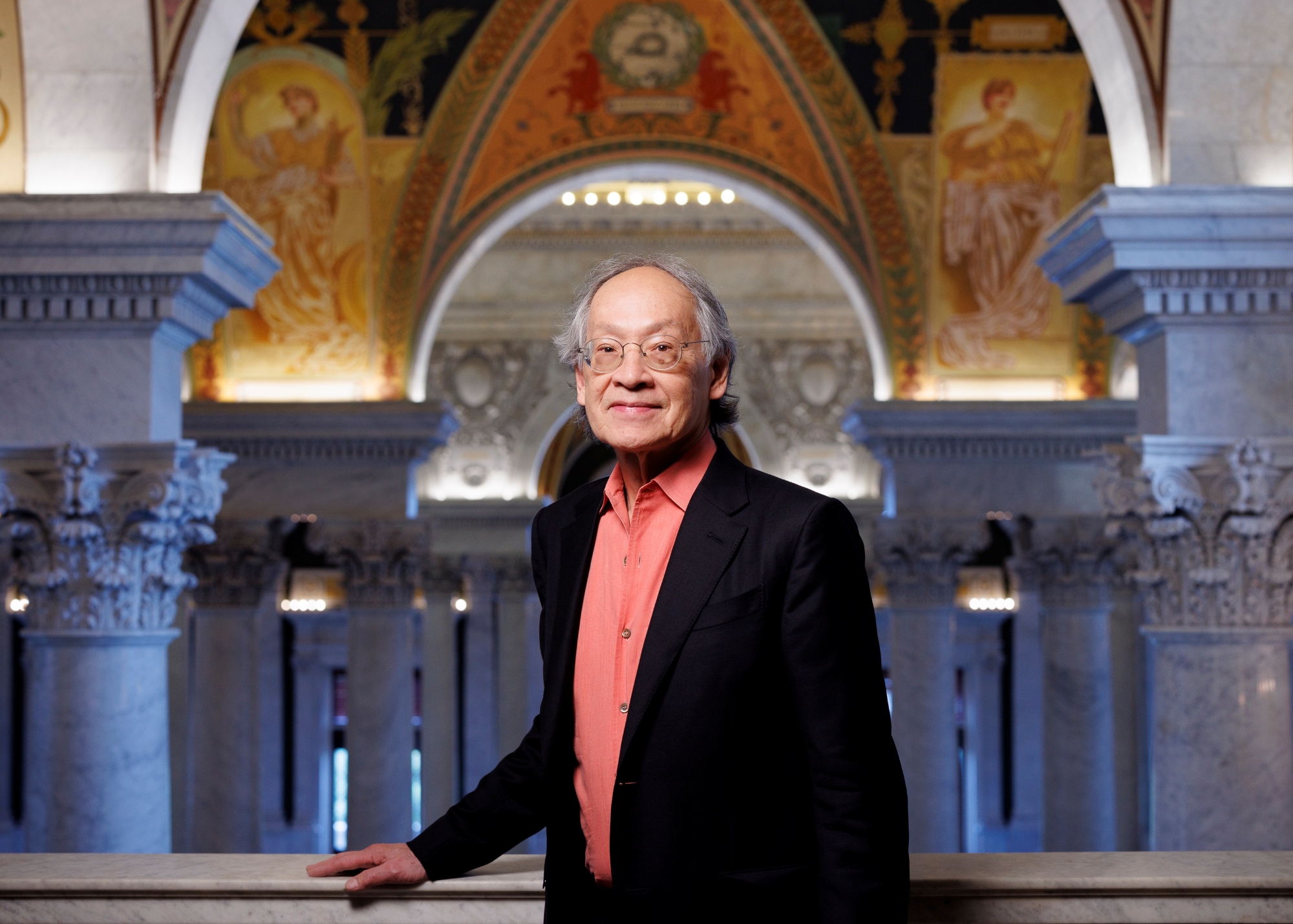
Arthur Sze ’68 was named by the Library of Congress as the 25th U.S. poet laureate for 2025-26 in September, following in the footsteps of Robert Frost, William Carlos Williams, Gwendolyn Brooks, Stanley Kunitz, Louise Glück, and many other luminaries.
The Bard Sublime
Arthur Sze ’68 was named the 25th U.S. poet laureate by the Library of Congress in September.

Robert Frost famously wrote:
Two roads diverged in a wood, and I—
I took the one less traveled by,
And that has made all the difference.
Frost, whose talent and renown earned him a berth as the U.S. poet laureate in 1958-59, used “The Road Not Taken” to convey an idea about making choices in the moment, the life such decisions reveal, and the other possibilities that are forsaken in the process. In a way, young Arthur Sze ’68 could see his own path unfolding before him. As a college freshman, he was enrolled at the Massachusetts Institute of Technology and studying chemical engineering — the very subject his father, Morgan C.Y. Sze P’64 ’68, transferred from Tsinghua University in China to M.I.T. to study in 1937. Science was important to the Sze family — a way of life, really.
“My parents were from Beijing and came to the U.S. for college. They spoke Mandarin at home but wanted us to focus on English during school years,” Sze told Ronald Mangravite ’68 P’18 in 2014 for The Lawrentian. “At Lawrenceville, I was strong in math and sciences, but a literature class with James Waugh [H’67 ’68 ’72 ’74 ’81 ’85 ’88 P’68 ’70 ’72 ’74 ’76 GP’12 ’14] introduced me to modern poetry.”
Sze began to realize his calling not long after when, during his first semester at M.I.T, he took what he called “an unexpected detour.”
“In an advanced calculus class, I suddenly began to write a poem,” Sze recalled. “After class I kept writing and didn’t stop.”
He never did, and that choice made all the difference to Sze, who was named by the Library of Congress as the 25th U.S. poet laureate for 2025-26 in September, following in the footsteps of Frost, as well as William Carlos Williams, Gwendolyn Brooks, Stanley Kunitz, Louise Glück, and many other luminaries.
“As the son of Chinese immigrants, and as a sophomore who decided to leave M.I.T. to pursue a dream of becoming a poet, I never would have guessed that so many decades later I would receive this recognition,” Sze said after his appointment.
As the U.S. poet laureate, Sze inherits the mantle that began in 1937, when Joseph Auslander was tapped to become the consultant in poetry to the Library of Congress. A 1985 Act of Congress revised the description to “poet laureate consultant in poetry to the Library of Congress,” or, more colloquially, U.S. Poet Laureate. Sze is the 25th person appointed under the revised title (Frost served under the previous appellation), which is credited with elevating the profile of the post. The laureateship is also a paid role.
According to the Library of Congress, the poet laureate is given the freedom to shape the position based on their interests and inclinations. Some have assumed highly visible roles as a national advocate for poetry; others forgo the spotlight to focus on their writing. During his term as poet laureate, Sze, who lives in Santa Fe, N.M., plans to have a special focus on translating poetry originally written in other languages. He published an expanded collection of Chinese poetry
translations, The Silk Dragon II, in 2024.
“His poetry is distinctly American in its focus on the landscapes of the Southwest, where he has lived for many years, as well as in its great formal innovation,” said Robert Randolph Newlen, acting librarian of Congress. “Like Emily Dickinson and Walt Whitman, Sze forges something new from a range of traditions and influences — and the result is a poetry that moves freely throughout time and space.”
In an advanced calculus class, I suddenly began to write a poem. After class I kept writing and didn’t stop.
Sze’s journey as a poet was buoyed early by the arrival at M.I.T. of poet Denise Levertov, whom he had studied at Lawrenceville, as a guest lecturer. Levertov recognized Sze’s poetic potential and advised him to transfer to the world-class literary program at the University of California, Berkeley. There, Sze continued writing and took advanced Mandarin to be able to study and translate the classic poets of the T’ang Dynasty. Legendary professor/poet Josephine Miles mentored him, having him read Rainer Maria Rilke and Pablo Neruda, and encouraged him to publish his work.
After graduation, Sze traveled to Santa Fe, where he accepted a position in the Poetry in the Schools program, taking him all over the state, working with students, Native Americans on reservations, and prisoners in maximum security — with one on death row.
“My job was to help people to express themselves,” Sze told The Lawrentian in 2014. “I would sit on the cold concrete walkways in front of the prisoners’ cells, listening as they read their poetry. I worked in this program for 10 years.”
A long stint followed as director of the creative writing program at the Institute of American Indian Arts in Santa Fe, where Sze remains a professor emeritus. He was also the first poet laureate of Santa Fe.
Native American and Asian cultures influence Sze’s poetry. Time and transformation are basic themes. Once, on a visit to the city of Chengdu in China, Sze encountered old men in a park at dawn painting on flat, black rocks.
“I discovered they were painting with water, writing out entire T’ang dynasty poems, which would evaporate as the
sun rose.”
This experience inspired Sze to write “Water Calligraphy,” part of his 2019 book Sight Lines, which won the National Book Award for Poetry.
“I am intensely aware of time passing and the brevity of our existence,” he told The Lawrentian in 2014. “I have a need to describe events and moments, to name them.”
Sze is the author of twelve collections of poetry, most recently Into the Hush (2025), as well as the prose collection The White Orchard: Selected Interviews, Essays, and Poems, which were both published in 2025. Poetry has been Sze’s sole career, garnished with a long list of honors: Guggenheim Fellowship, American Book Award, Lannan Literary Award, two NEA writing fellowships, and the Jackson Poetry Prize. His ninth book, Compass Rose, published by Copper Canyon Press in 2014, was a finalist for the Pulitzer Prize.
We live in such a fast-paced world; poetry helps us slow down, deepen our attention, connect, and live more fully.
“The compass rose is the map symbol that helps geographically orient the reader,” Sze explains. “I am trying to identify the yearning for spiritual centering, to locate, to root ourselves.”
Succeeding Ada Limón, Sze officially began his laureateship on October 9 with a reading of his work in the Library of Congress’s historic Coolidge Auditorium in Washington, D.C. In the days leading up to the event, he was filled with a sense of duty to foster engagement with the art that has defined his
adult life.
“As laureate I feel a great responsibility to promote the ways poetry, especially poetry in translation, can impact our daily lives,” Sze said. “We live in such a fast-paced world; poetry helps us slow down, deepen our attention, connect, and live more fully.”
* * *
Portions of this story first appeared in “Writing with Water” by Ronald Mangravite ’68 P’18 in the winter 2014 issue of The Lawrentian.