Encore: Fall 2025
Revealing NYC’s Sandhogs
Tom Grimes ’78 brought the underground world of “Sandhogs” to the Hutchins Galleries.
Early in his career as a photographer, Tom Grimes ’78 worked in New York as an assistant to several notable fashion lensmen. Even once he became established on his own, Grimes’ work remained very much on the glamourous side, shooting for such glossy publications as W, Seventeen, and Harper’s Bazaar.
Eventually, Grimes’ eye for beauty moved him toward photographing architecture, which remains his primary focus. But in his latest exhibit, “Sandhogs,” Grimes turned his lens underground, toward what might be the antithesis of glamour in New York City: the workers behind the city’s bridges, tunnels, and underground systems. His photographs offer a rare and striking glimpse into the lives of those who’ve helped build the city from below.

“Tunnel #3,” from 1997, was part of the black-and-white photography exhibit “Sandhogs,” featuring the work of Tom Grimes ’78.
“Sandhogs” was on display at Lawrenceville’s Hutchins Galleries from September 11 through November 14, revealing in stark black-and-white the lives of the workers who make their livings some five hundred feet below street level.
In the image titled “Tunnel #3,” we see the portrait of a grim-faced, helmeted workman pausing from the seemingly endless task of boring a new 60-miles water-supply tunnel for the city’s system. The timeline of the project is a literal lifetime; work began in 1970 and is not expected to end before 2032. In that time, twenty-three sandhogs and other workers have lost their lives to the effort – a disheartening figure reflected in the countenance of the 1997 photo’s subject.
Creating Sets, Building Skills
Foundations of Theatre offers more than an introduction to the stage. It’s a space to build skills, confidence, and connection.
At Lawrenceville, the Foundations of Theatre class isn’t merely about learning lines and stagecraft so much as it is a transformative journey of self-discovery and creative exploration. Spanning two terms, the course delves into the fundamental elements of theater, blending theoretical insights with practical skills that resonate far beyond the stage of the Kirby Arts Center, or KAC.
Led by performing arts teacher Jamie Cuthrell, the class begins by studying Aristotelian theory and progresses through guideposts of theater and elements of design. These frameworks deepen students’ understanding of dramatic storytelling and empower them to apply these principles practically. From analyzing plot dynamics to creating immersive stage designs, every lesson integrates theoretical knowledge with hands-on experience.
Offstage, students immerse themselves in the design process, making decisions on scenic, costume, and prop choices with an artist’s eye.
“They each design their own set for a scene in the play She Kills Monsters by Qui Nguyen, drawing ground plans and elevations,” Cuthrell said. “They’re thinking about how space shapes
storytelling — what’s onstage, what’s not, where the entrances are, how the environment supports the action.”
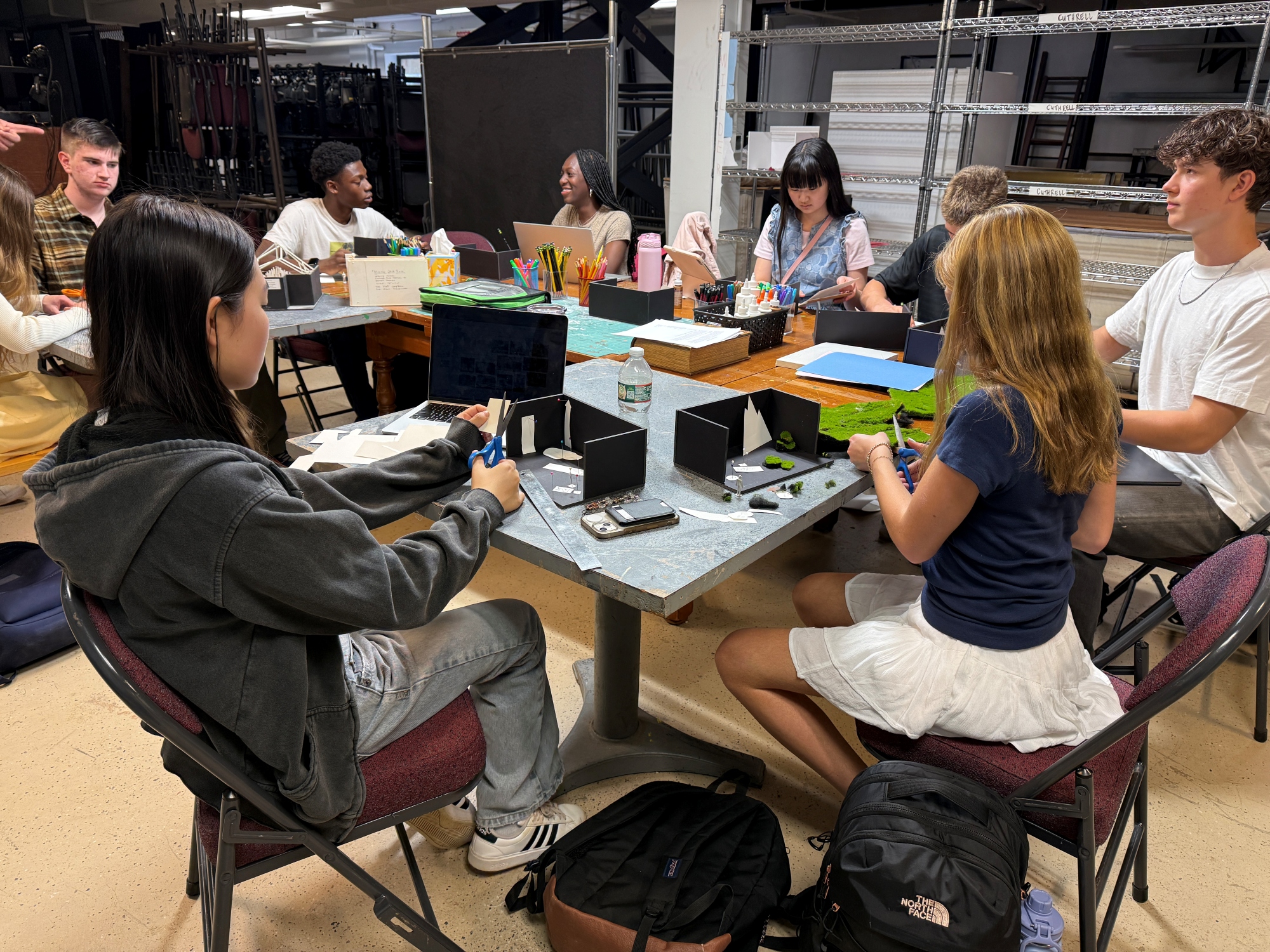
Students in the Foundations of Theatre class assemble scale models of stage sets.
Students also engage in creating physical design elements, such as mood boards and 3D models.
“Some of them bring in cardboard or clay or even use Lego to build out their designs. It’s tactile and thoughtful,” Cuthrell explained. “Design is just as expressive as acting. It’s asking: What story are we telling, and how do we show it without words?”
The class embraces Lawrenceville’s Harkness approach, relying on discussion, observation, and constructive feedback. Students critique one another to move beyond empty praise to meaningful insight, fostering a culture of trust and collaboration that mirrors Lawrenceville’s ethos of Harkness learning — where every voice matters, and every perspective enriches the collective experience.
Luke Pometti ’25 recalled Foundations of Theatre as one of his favorite classes during his four years at Lawrenceville. He credits the course — and its teacher — with boosting his confidence and preparing him for performances in Second Form Shakespeare and WinterFest.
“Theater at Lawrenceville is associated with joy, fun, and excitement, largely due to Mr. Cuthrell and his Foundations of Theatre class,” Pometti said. “He’s a teacher who not only wants to teach the subject but wants to teach it to you — and you want to learn from him in return.”
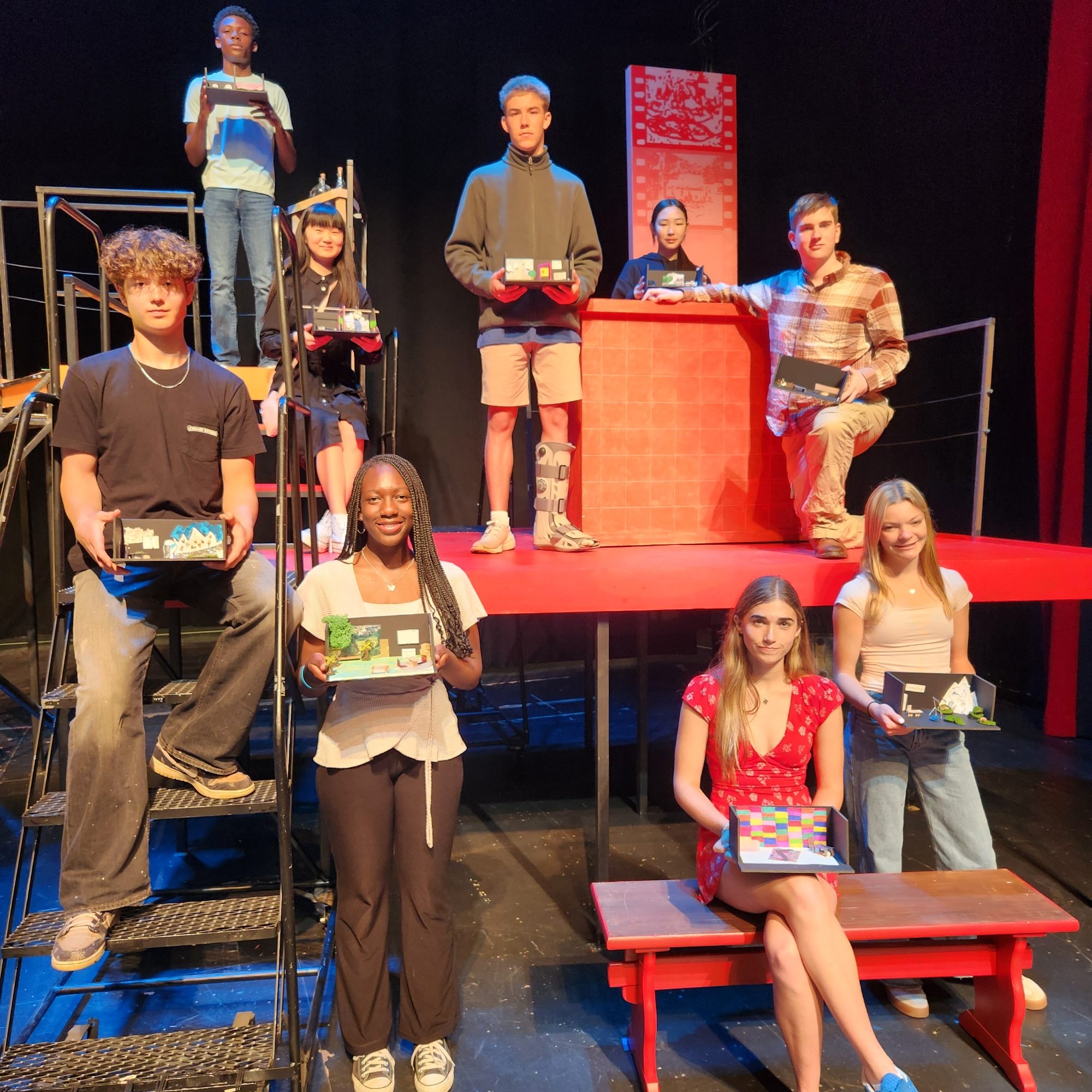
Foundations of Theatre students show off their diorama-style set designs they created under Performing Arts teacher Jamie Cuthrell.
Beyond artistic merits, the Foundations of Theatre class equips students with invaluable life skills: confidence in self-expression, resilience in facing challenges, and empathy in understanding diverse perspectives. It’s a curriculum that not only prepares them for future theatrical pursuits but also nurtures their growth as individuals.
J.C. Clemons ’28 applies the skills learned in class to life outside the KAC.
“Communication and building relationships with peers during acting helps you become better acclimated to your community and improves compatibility with peers,” he said.
For Xinxin Yang ’28, the class has nearly cured her stage fright.
“I’ve gained confidence in performances. Even when I forget a line, I can now quickly improvise and save the moment,” she explained. “Theater is where you can feel free to express yourself — be loud and proud. What’s the fun in theater if you don’t pour your heart into it?”
– Lisa M. Gillard H’17