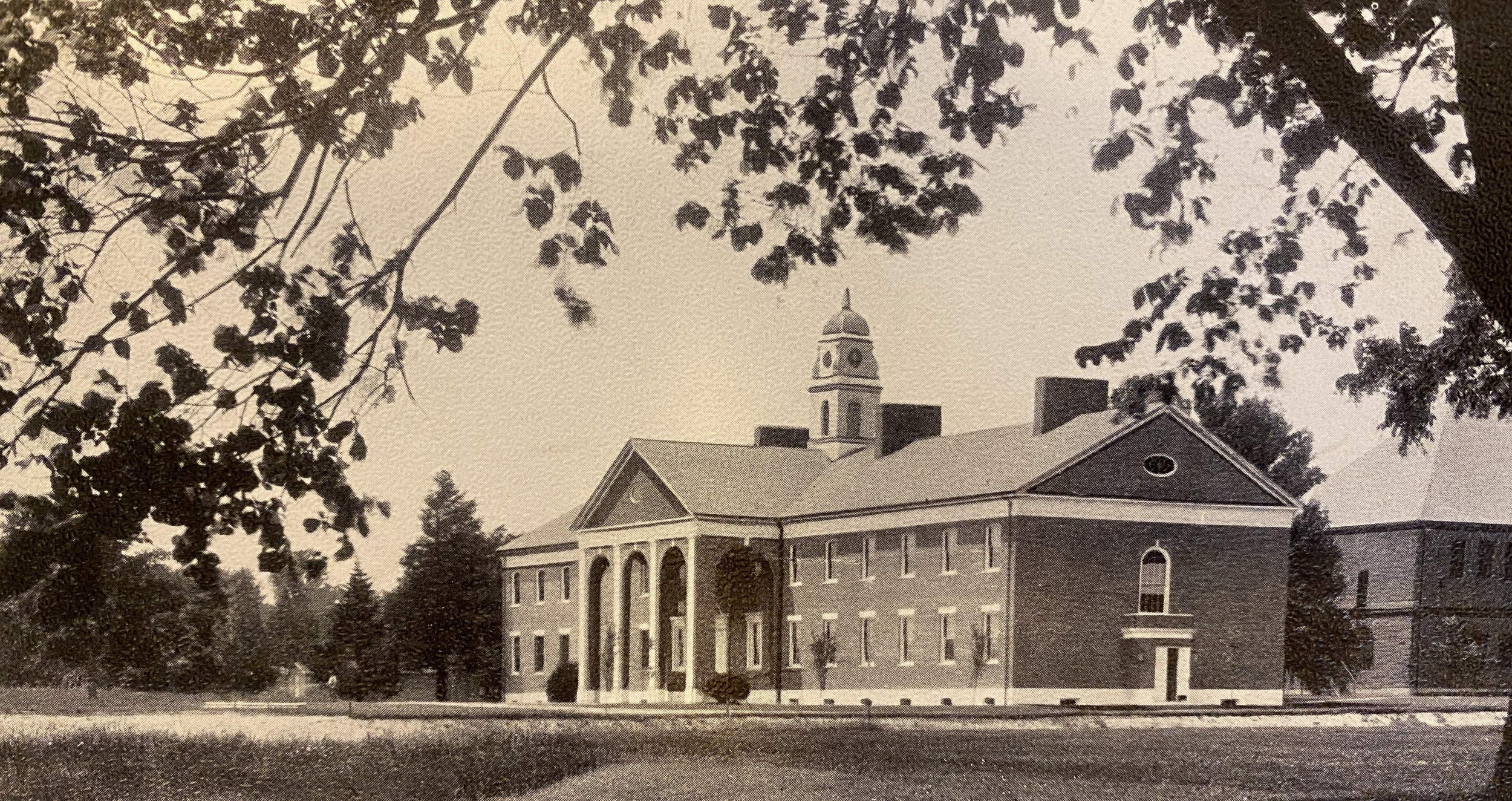
The Fathers Building in 1926, months after it opened to students as a “recitation building.” Note the absence of Raymond House or the Mackenzie Building in the foreground.
A Radical Transformation
The Fathers Building, which celebrated its centennial in 2025, enjoyed a sweeping refurbishment a dozen years ago. But the edifice also was fundamentally altered barely a decade after it first opened.

The Fathers Building — the stately Georgian Revival structure that stands at the head of The Bowl — celebrated its centennial in 2025. And while many Lawrentians recall its complete 2013 renovation, the venerable “Pop Hall” was barely a decade old when it underwent its first makeover following Lawrenceville’s adoption of the Harkness method of classroom pedagogy.
Over the course of eighty-eight days in 1936, Pop Hall’s original 1925 interior, which included a student milk bar, was gutted and reconfigured to accommodate “Conference Rooms.” Each room measured 17 by 23 feet, each with two closets, a built-in bookcase, and an 11-by-7 elliptical West Virginia soft maple table weighing 950 pounds. Spurred by the generous philanthropy of Edward Stephen “Ned” Harkness, this conversion enabled his revolutionary method of instruction, now integral to the School’s mission, to become a hallmark of Pop Hall’s rich century-long history.
Constructed in 1925 after three years of intense fundraising by the Fathers Association, Pop Hall was designed by William Adams Delano of the Class of 1891 in a “Colonial style” and officially named “The Fathers Building” in honor of the progenitor of today’s Parents@Lawrenceville. The building was made from brick and incorporated steel joist construction, which was an emerging architectural support method. The building boasted classrooms, administrative offices, three separate lounges –one for faculty, one for alumni, and one for parents – a bookstore, a printing room, three student publication offices, a faculty billiards room, and two lavatories. Although sumptuous and functional, Pop Hall’s initial design would soon prove unsustainable for the School’s future.
When Allan V. Heely H1927 was appointed head master in 1934 — nine years after Pop Hall was erected — the School was in the midst of navigating the Great Depression and a rapidly changing college admissions process. Regardless of these challenges, Heely was determined to elevate the academic standards set by his late predecessor, Mather Almon Abbott, as well as to address deferred maintenance on campus buildings. Heely immediately engaged in fundraising efforts but was reluctant to contact renowned philanthropist and Standard Oil Co. heir Ned Harkness for support.
Harkness formed strong opinions on education after graduating from both St. Paul’s School and Yale University, where he experienced regimented schedules packed with formulaic lectures. He believed that American institutions needed to “adapt the curriculum and the physical plant in such a way as to encourage the redevelopment of a close student-teacher relationship.” His solution was to adopt elements of progressive British pedagogical methods – namely the use of circular tables, which first appeared at Cuddesdon College in the 1850s, in place of desks. “[Students] could sit around a table
with a teacher who would talk with them and instruct them by a sort of … Conference Method,” Harkness said.
Although Harkness’ pedagogical technique was radical, Heely knew that Phillips Exeter Academy successfully implemented Harkness’ Conference Method in 1930. He also quickly surmised that if Lawrenceville executed the Conference Method with Harkness’ support, his goal to address deferred maintenance and achieve academic excellence was within his grasp.
After six months of correspondence, Harkness agreed to fund Heely’s comprehensive proposal on June 1, 1936. The agreed-upon plan included the creation of an administrative building, an endowment to hire additional faculty, and renovations to the academic buildings to accommodate conference-like classrooms. Just twenty days later, the Matthews Construction Co. began to work on both Memorial Hall and the Fathers Building under the oversight of Delano, who was rehired to reimagine the structures’ interior spaces.
Construction in Pop Hall was extensive: Walls were repositioned, floors were replaced, mechanical systems were updated, and the beloved milk bar was removed. In addition to closets and a built-in bookcase, an assortment of arches and pediments were added to each conference room as architectural accents to avoid visual monotony. Mohair curtains and paint colors, notably similar to those in Harkness’ Connecticut residence, were selected by Heely’s wife, Pattie H’55, in concert with Delano for the building.
Once the faculty began to move into the building, the interior design of Pop Hall changed even more, as they were encouraged to accent their teaching spaces with collectibles, artwork, and books that reflected both their academic discipline and personal tastes. The resulting eclectic-yet-uniform
nature of Pop Hall’s conference rooms was casual in comparison to rows of desks facing a chalkboard. “[S]tudents … have felt and enjoyed the informality … . They have taken part more freely in group discussions, have asked more questions, [and] have carried discussion more frequently beyond the classroom walls,” Heely said. “The Harkness gift has given Lawrenceville a limitless opportunity.” Heely’s goals had been achieved.
Pop Hall’s 1936 renovation remained largely intact until 2013, when the building was renovated and updated for a second time. Although the building underwent a few significant changes, such as turning the basement into a technology hub and updating mechanical systems, the essence of Harkness and Delano’s influences remained. With more than just a nod to environmental sustainability, the renovated Pop Hall earned LEED Silver certification from the U.S. Green Building
Council in 2014.
Not all of Pop Hall’s historical throughlines are of the architectural variety. Mort Fuller III ’60 P’89 ’01, whose grandfather was a leading member of the Fathers Association that funded the building’s construction in 1925, played a key philanthropic leadership role in its 21st-century refurbishment; his father, Mortimer B. Fuller ’28, was one of the first to enjoy the original edifice as a student. A full century after it first rose behind what is now Woods Memorial Hall, the Fathers Building is poised to remain at the center of Lawrentians’ essential search for truth around the Harkness table.
* * *
Sarah Mezzino is the curator of decorative arts & design for The Stephan Archives. This article was inspired by research conducted for the exhibit “Canceled Culture: First Day Covers and Historic American Stamps,” on display in Bunn Library through 2026.